
RIC Social Work Professor Wants Society to Understand Homelessness
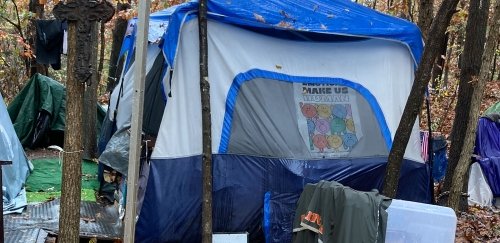
For nearly 20 years, Assistant Professor of Social Work Megan Smith, M.S.W. ’16, who earned her Ph.D. in social work at Boston University in 2022, has dedicated her career to building relationships with people experiencing homelessness, not from behind a desk, but face-to-face.
Her days are filled with classes at Rhode Island College and with serving as an outreach worker and experiential education coordinator with Rhode Island Street Medicine, a program initiated by Brown University Health that delivers health and social services to people experiencing unsheltered homelessness. Services are delivered in the environment of those who are homeless.
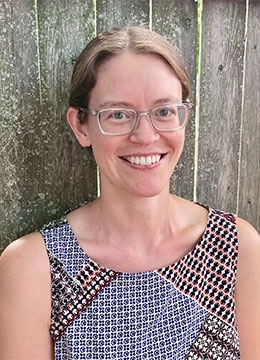
Since April 2007, Smith has been advocating with and for homeless individuals. “The first time I got involved with homelessness was at a protest to stop the state from demolishing the Welcome Arnold Shelter in Cranston,” she says. “Right then, I knew this was the community of people that I wanted to work with for the long haul.”
Her part-time job with Rhode Island Street Medicine’s interdisciplinary team provides point-of-care support, including medical needs, such as wound care and access to prescriptions; shelter and housing referrals; and ongoing case management.
“Sometimes the most important thing we do is spend time talking with homeless individuals. Trust takes time. Especially when many have had painful experiences with systems of authority, including social workers,” she says. “If someone doesn’t want to talk, I don’t push it.”
“For most of us, homelessness can feel distant, someone else’s issue, a statistic, a headline, but up close, it is deeply human,” Smith says.
Most of the people she works with are unsheltered. Some feel that congregate shelters are unsafe or retraumatizing. They may not trust institutions. Couples may decline shelter because there are no beds that allow them to stay together. Other individuals may refuse to leave a beloved dog. And there are those who avoid warming centers during a cold wave because they fear their belongings and tent will be gone when they return.
Recently, an older woman Smith had been checking in on for months finally called her and said, “I’m ready to go inside.” Within hours, arrangements were made at a local warming center. The next morning, Smith received a text message from the woman, saying, “That was the best sleep I’ve had in ages.”
For Smith, “It shouldn’t be extraordinary that someone gets a night of warm sleep indoors. But given everything this woman has been through, it felt huge,” she says.
One of the most common misconceptions about homelessness, Smith says, is that it is a personal failure, that people are in that situation because they are bad people or made bad choices. Her response is firm, “We’ve all made mistakes, but some of us are socially positioned in a way that insulates us from the consequences of those mistakes.”
“A person with savings, family support or stable employment may recover from a financial shock. Someone living paycheck to paycheck, particularly someone who has experienced racism, foster care involvement, trauma or untreated mental illness, may not have that margin for error,” she says.
According to Smith, homelessness is rarely caused by one single factor. “It’s multi-factorial. Mental health and substance use are often cited as primary causes of homelessness. But at the root is housing unaffordability,” she says.
When Smith began this work nearly 20 years ago, Supplemental Security Income payments were around $600 per month and apartments could still be found in that range. Today, monthly Supplemental Security Income is under $1,000, and even a modest studio costs far more.
“Back then, it was tight, but possible. Now, it’s just not doable anymore,” she says. “Mental illness can contribute to housing instability. But homelessness itself is deeply traumatic and can worsen anxiety, depression and PTSD.”
“Substance use may be a contributing factor for some, but it is also, in many cases, a coping mechanism,” says Smith. “When you look at what daily life is like outside – the cold, the stigma, the constant stress – I can understand why someone would want to numb that or artificially energize themselves just to get through the day.”
“That does not mean homelessness can happen to anyone in the same way,” she says. “Structural factors matter – race, disability, family history and poverty are all influential risks.”
When asked how society can make a difference for those who are homeless, Smith points to housing. “Permanent supportive housing and ‘Housing First’ approaches that provide housing without requiring sobriety or treatment compliance have consistently shown strong outcomes,” she says. “Expanding the affordable housing supply is critical. But more than anything, it is critical to listen to the people directly impacted when we’re thinking about solutions. Nobody knows better how to address and end homelessness than the people who are living it.”
Smith also brings her work to the classroom. At Rhode Island College, she teaches a course titled “Homelessness: Clinical and Policy Interventions.” Originally drafted when she was a grad student, it brings together social work and medical students from the Warren Alpert Medical School.
For several years, the class has featured guest experts who have had lived experiences with homelessness. “This past year, my co-teacher was Donn King, who experienced homelessness,” she says. “To teach with someone with that perspective is a fountain of wisdom.” Smith’s students also have the opportunity to engage in outreach as part of the course.
“I want them to know that change will not come from stereotypes or slogans,” she says. “It will come from conversations – the kind that happen in vans, on sidewalks and sometimes in classrooms.”
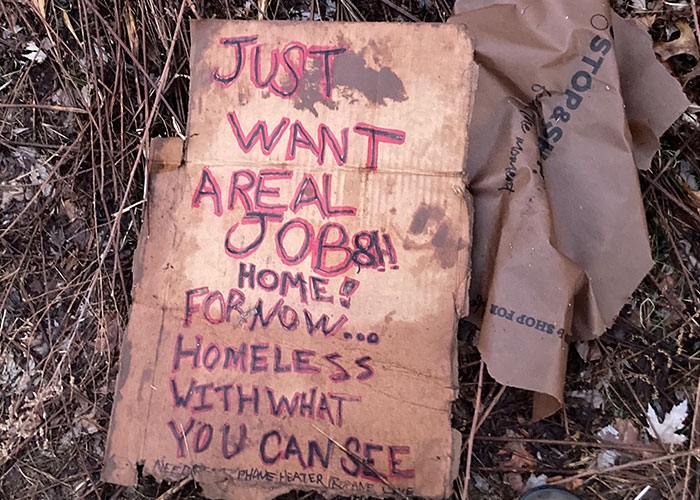
These photos were taken locally by Megan Smith during her work with the homeless. Learn more about RIC’s social work programs.