
What Powers AI and What Is It Costing the Earth: RIC Experts Respond
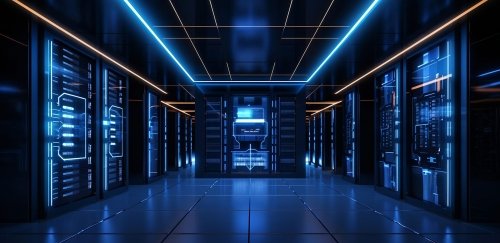
Public backlash against the building of large capacity data centers that power AI is spreading across the country. Working around the clock, data centers house thousands of high-powered computers that process data 24/7. They not only consume massive amounts of electricity, they generate intense heat.
To prevent equipment failure or fires, millions of gallons of water are required to keep the facilities cool and to control humidity.
The “catch” is that because the heat is carried away by water, which then evaporates into the air, data centers have to draw millions of gallons of continuous fresh or reclaimed wastewater from municipal supplies to replenish their systems.
Neither electricity nor water are infinite resources. They can be depleted. Hence, the public backlash.
RIC experts say there is an environmental cost to AI and that data centers need to do what they can to protect the planet from the worst possible outcomes.

Professor Timothy Henry, director of Rhode Island College’s AI program, is also a member of the governor’s AI Task Force.
It is important, he says, to dispel the public misconception concerning water scarcity. Water usage by current data centers amounts to a tiny fraction of all U.S. water use, he says.
“In fact, the top four water consumers are: thermoelectricity, mining, forest products and home leaks. The average household leaks 180 gallons of water a week; that’s 9,400 gallons annually and 900 billion nationwide over a year,” says Henry.
“This is not to downplay the water consumption by data centers,” he says. “With more and more centers being built, the usage rate is going up. If we don’t manage their growth, there will be water supply issues.”

Doug Alexander agrees that “the water issue is smaller in magnitude than the use of electricity.” He is director of the Institute for Cybersecurity and Emerging Technologies at Rhode Island College.
“Water issues are highly localized,” Alexander says. “While the usage rate may not be concerning when put up against other industries, there could be very real concerns in arid regions where groundwater is already scarce. It would also affect the groundwater supply in areas that have heavy concentrations of data centers, which are Virginia, North Dakota, Nebraska, Iowa and Oregon.”
“Currently data centers in the U.S. use 19 1/2 billion gallons of water for direct cooling a year,” says Alexander. “By 2028 that’s estimated to increase to 38 to 73 billion gallons of water a year. I don’t think people are wrong to be concerned.”
“If all the data centers the tech industry wants to build are, in fact, built, it’ll represent an immense jump in electricity and water consumption, and that’s definitely a threat to sustainability,” he says.
Some of the proposed data centers that tech companies want to build are the size of cities. Facilities can range in size from small 5,000-square-feet structures to massive 10+-million-square-feet “hyperscale” campuses. Hyperscaled, their electricity needs would expand to the gigawatt power scale to support intensive AI workloads.
Recently in Utah, a tech company was given the go-ahead to build one of the largest data centers in the world, twice the size of Manhattan, resulting in a huge backlash by the citizens of Utah.
According to Food & Water Watch, “Hyperscale data centers…can consume five times more energy than pre-AI data centers. A single hyperscale AI data center can consume as much energy as 100,000 households, and the largest as much as 2 million.”
“My fear comes in knowing the hodge podge of our electrical grid,” says Henry. “It’s not a nice, unified electrical supply grid.”
“I fear that either our electricity rates will go up or companies will start recommissioning fossil fuel plants and make the climate change situation that much worse,” says Alexander.
“Already Big Tech firms are walking back a lot of their climate pledges and carbon neutral pledges because they can’t support it with the data centers they’re talking about building. Their most economical option is to build gas turbines next to the data centers and power them locally,” he says.
He cited Elon Musk. Hungry for electricity but unable to find enough of it on the grid, his AI company built dozens of illegal methane gas turbines next to his hyperscale data centers to meet their massive electricity needs.
There are cleaner alternatives, says Henry. He pointed to a renewable-energy data center in Massachusetts called the Massachusetts Green High-Performance Computing Center, which services many universities, including URI, and uses solar panels to generate electricity. “This is a great example of how companies can find more eco-friendly means to power their facilities,” Henry says.
Alexander suggests more energy-efficient AI models and greener chips. “The building and training of large AI models is extremely energy intensive,” he says. “AI models have to run at maximum capacity for many, many thousands of computing hours. It can take weeks or months to train them. That’s where the energy and water usage comes in.”
Neither Henry nor Alexander are against data centers. “Data centers predate AI,” Alexander says. “And AI has changed the way I work and changed coding forever. However, data centers are disproportionately affecting some states more than others, as I mentioned earlier. It is also disproportionately impacting the less privileged, the less monied and the less powerful.”
“What we need is controlled growth of these centers,” says Henry. “It’s important for each municipality to plan well, to look at how many centers their current infrastructure can support over the next five to 10 years and to work within that plan.”
“And it’s incumbent upon us to say what is a sustainable way to build these data centers at a scale that’s tolerable for our infrastructure,” says Alexander. “We need to have a constructive conversation about growing AI and data centers that isn’t led purely by profits. Instead, our conversation should be moderated by societal needs and capacities and the economic benefits. It would go a long way toward taking the temperature down in all these data center conversations.”