
Should I Live on Campus or Commute?

“Currently over 800 students live in Rhode Island College residence halls. Fifty percent of them are first-year students,” says RIC Director of Residential Life Darcy Dubois.
“I highly recommend that all first-year students live for at least one year on campus,” she says. Here are seven reasons why:
1 – Full College Experience
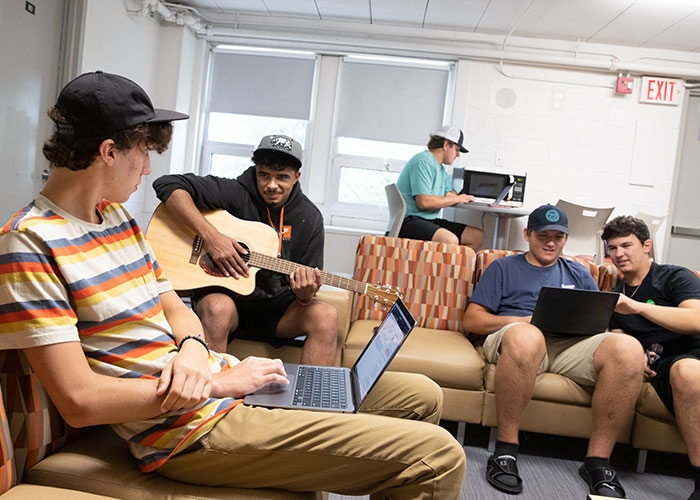
“Living on campus really immerses students in campus life and gives them the full college experience,” she says. “It’s much easier to socialize and build a community when you’re living on campus. Residents are constantly meeting up with friends, going to campus events together and they love to congregate at the Donovan Dining Center, the Beestro, Adams Library and in their suites. Every building lounge has either a pool table or a ping pong table.”
2 – Amenities and Convenience
“Room and board covers utilities, internet and meals. When you break down these costs and compare them to renting an apartment off campus, it comes out much cheaper,” says Dubois.
There’s also the convenience of living on campus, she says. Everything is in walking distance, which eliminates commute time. You don’t have to worry about traffic or about circling the campus in your car to find a parking spot. “Parking is free and the library, recreation center, dining hall, health services and counseling services are all close by,” says Dubois. “All of these amenities are provided in a nice, neat package.”
3 – Safety and Support
“There are RAs on every floor who get to know their residents. They are trained to assess for emergencies or for changes in behavior. And because they’ve already gone through their first year at RIC, they’re able to give advice about classes, professors or just life advice. Students have an instant mentor in an RA,“ says Dubois.
“RAs live in the residence halls and are on duty every night and weekends. They’re always doing rounds to make sure everything and everyone is safe. At the same time, the campus police are doing their rounds, checking the outside of buildings 24/7. We have a very safe campus with cameras everywhere,” she says.

“We also have a Care Team on campus, which I lead,” Dubois says. “Like Starfish – an online platform where faculty and staff can post their academic concerns about a student – the Care Team is where anyone can share their concerns about a student’s social/emotional well-being. Just go online, fill out a form explaining your concern and the Care Team will choose which member of the team is the best person to reach out to that student based on the student’s need.”
4 – Soft Transition into the Real World
“I always tell students, ‘Living on campus is a soft transition into the real world. It’s a good place to make your mistakes before you’re out in the real world,’” says Dubois. “On the very first night that residents move in, RAs hold a first-floor meeting where they explain all the rules of living on campus, such as no alcohol or marijuana, and they’ll talk about the quiet hours. They’ll explain that to live in a community, you have to start thinking differently, you have to be respectful of your suitemates.”
5 – Self-Discipline
“When you’re living away from home, you have to learn to be independent,” she says. “You have to be able to get yourself to class on time and to manage your homework. You have to learn to live on your own and to manage yourself. You don’t have a curfew. You don’t have mom or dad waking you up in the morning to make sure you get to that 8 a.m. class. You’re responsible for getting to class and for meeting your other responsibilities.”

6 – Communication / Conflict Resolution
“Another part of transitioning to the real world is learning to communicate with others, specifically your roommate and suitemates. What I’ve noticed in my 20-plus years in the residential life industry is that communication has gotten much more difficult for students because of social media and the COVID pandemic,” Dubois says.
“Social media and COVID have really stunted students’ ability to communicate with each other. Because they’re so used to communicating behind a screen and texting, they have a hard time sitting face-to-face and saying, ‘Here are my feelings. This is what I don’t like. This is what I do like.’ They see that kind of communication as confrontation, when it’s really just talking things out. RAs do a lot of mediations to help students have these conversations.”
7 – Cleanliness
“The biggest challenge for first-year students is keeping their spaces clean,” she says. For some residents, cleaning their bedrooms, the bathroom and other communal spaces comes easy, but for others, it doesn’t. RAs spend a lot of time doing mediations around this, as well.”
Ultimately, Dubois encourages every student – residents and commuters – to become part of the RIC community. She particularly urges commuters to get involved and to resist the temptation to eat or study in their car. Meet up with classmates, relax in a communal space, join a student club, attend campus events, become a part of the community, because the RIC community is here for you.

Learn more about Residential Life and Housing at RIC.