
RIC Offers New Teaching Apprenticeship Program

Apprenticeships have been a part of the trades for generations, but in education, the first teacher apprenticeship program was only rolled out four years ago in Tennessee. Last year RIC became the first institute of higher education in Rhode Island to offer a certification pathway for teaching apprentices in the state of Rhode Island.
Offered through RIC’s Feinstein School of Education and Human Development, the Registered Teaching Apprenticeship Program (RTAP) provides a pathway for pre-K-12 paraprofessionals, such as teaching assistants, to lead classrooms of their own as licensed educators.
This is a joint collaboration between Rhode Island College; Building Futures (the leading experts in apprenticeships in Rhode Island); the Institute for Labor Studies and Research; pre-K-12 school districts; and three unions: the RI AFT, the NEA of RI and the AFL-CIO.
To be eligible, paraprofessionals must have a bachelor’s degree (any discipline) and work full time in one of the partnering pre-K-12 school districts.
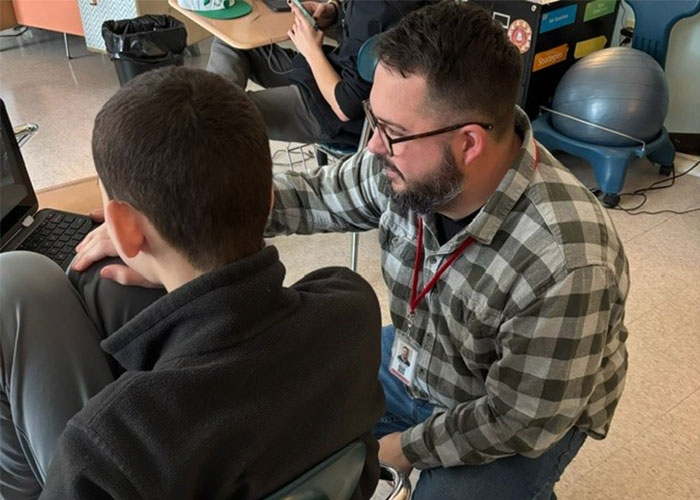
RTAP Program Director Jason Midwood, who for a decade worked as an education consultant specializing in school redesign and reform and then went on to work for another 10-plus years for the Central Falls School District, says that in a country suffering from a major teacher shortage, paraprofessionals are an untapped talent pool.

“Many of our paraprofessionals are multilingual and live in the communities they work in,” says Midwood. “Many of them have degrees either from their home countries or in other industries. They want to become formally trained teachers. The difficulty is that they would have to take an unpaid leave of absence in order to earn their degree. So, they compromise their dream to do what’s economically best for themselves and their family. There’s a lot of talent that we’re losing because of that. The talent is there. It’s just that we, as a system, aren’t looking in the right places.”
RTAP was created to remove the barriers. It’s an “earn-as-you-learn” program, where paraprofessionals can continue working in their current classroom while taking classes in the evening or on-line, dependent on the program they pursue.
The apprentice works with their classroom teacher/mentor to fine-tune the skills they’re learning at RIC. And their mentor helps ensure that they are meeting the competencies prescribed by the Rhode Island Professional Teaching Standards.
RTAP is also a grant-funded program that provides generous tuition support. Midwood notes, “Seventy-five percent of the current cohort stated they would not have been able to go back to school, had it not been for the tuition support.”
Program completion may be possible for some as quickly as 15-18 months, depending on their area of specialization. Once they pass their courses at RIC, the appropriate Praxis exam(s) and student teaching at their current school, they will be eligible to apply for certification through the Rhode Island Department of Education.
“Paraprofessionals could go from making $40,000 a year to possibly $60,000 a year as a first-year educator in the state of Rhode Island, depending on the district,” says Midwood.
He notes that Rhode Island College has the most rigorous teacher preparation program in the state of Rhode Island. “But our apprentices also come with a wealth of knowledge of their own,” he says. “Many of them have been in the classroom longer than the classroom teacher. And many are multilingual. These are people who already know the culture, the community, the curriculum and the kids.”

“Our first two apprentices from Central Falls, who started the program in the fall of 2025, will complete the Certificate of Graduate Study in early childhood special education at the end of fall 2026,” says Midwood. “One of them, Rosa Goncalves, is fluent in four languages and has a background in human family development. She’s been in the early childhood/early intervention sector for more than 20 years. Dolca Mendoza has been a paraprofessional for 20 years in the Central Falls school district.”
These apprentices are also helping to fill a deficit of another kind.
“The talent deficit right now in many school districts is special education,” says Midwood. “Across the country, we’re just not producing enough special education teachers. At RTAP, our focus is on closing the gap on hard-to-fill certification areas. All but one of our current apprentices are earning certification in special education. It is, by far, the biggest need. Many paraprofessionals have already been working in that field. Eighty-seven percent of paraprofessionals in the United States work with students with disabilities.”
Midwood, a RIC alum himself who earned his secondary education teaching degree in history in 2003, says he feels honored to lead this apprenticeship, “particularly at a college where I myself was trained as an educator. It makes it even more special for me. It’s a full-circle legacy.”
For more information, see: RTAP or contact RTAP Program Director Jason Midwood at 401-456-8877, or email him at rtap@ric.edu.