
RIC Faculty & Staff Say “Sí” to Spanish
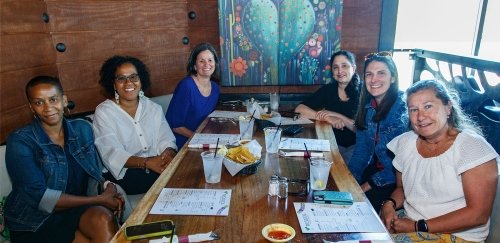
This spring, Rhode Island College’s Department of Modern Languages launched its first introductory Spanish 101 course for all full-time RIC faculty and staff. Almost 90 employees signed up.
According to Department Chair and Professor of Spanish and Latin American Studies David Ramirez, there are many reasons why people want to learn Spanish – from personal to professional reasons. Ultimately, for Ramirez, this initiative is all about community building. He believes that by learning Spanish, faculty and staff will be better able to serve the growing Spanish-speaking community both on campus and off.
“The languages that we offer here at RIC are the languages of our communities,” says Ramirez. “You don’t have to take a plane to find the core of Spanish-speaking and Portuguese-speaking communities. Just drive five minutes or step out the door into your neighborhood and there they are. Learning the language of a community creates not only stronger connections with that community, it builds a bridge to deeper cultural understanding.”
This is a non-credit, no-cost, hybrid course conveniently held at the close of regular work hours. It meets in-person once a week and online once a week. Though almost 90 employees expressed interest in it, the class was limited to 30 students. The 60 who missed the cut-off point, are on a waiting list and will be offered the course again in the fall.
It is taught by Isa Tejada, a RIC alumna who graduated in 1997 with a B.A. in secondary education with a concentration in Spanish. Tejada went on to teach Spanish and is currently vice principal of Cranston East High School.
For this course, her goal, she says, is “to provide an opportunity for all staff members to learn basic conversational Spanish while exploring the many cultures within the Spanish-speaking world.”
“I really appreciated her teaching style,” says Sheri Boucher, RIC associate professor of nursing. “It was less focused on the memorization of words and more on just getting the gist of what was being said.”
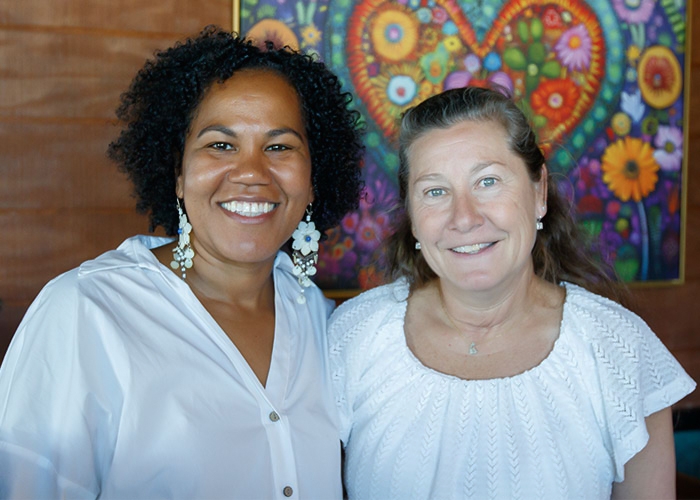
Tejada is happy that her intention was felt by her students. “I wanted everyone to feel comfortable learning the language in an environment where mistakes and errors are welcome,” she says.
“I also appreciate how much time she spent on teaching us about different cultures,” says Jeanmarie Pariseau, director of annual giving. “For instance, in one lesson, she opened our eyes to the different nuances found in the Spanish language. She recorded students at Cranston East High School, who are native Spanish speakers. And then pointed out the differences in how rapidly one student spoke who was, say, from Puerto Rico compared to another student who was from the Dominican Republic, or how some Spanish speakers drop the last letter of the verb.
“She also incorporated music, food, dance. I can’t emphasize enough how rich this class was. There was so much laughter in the classroom, you didn’t even know you were learning.”
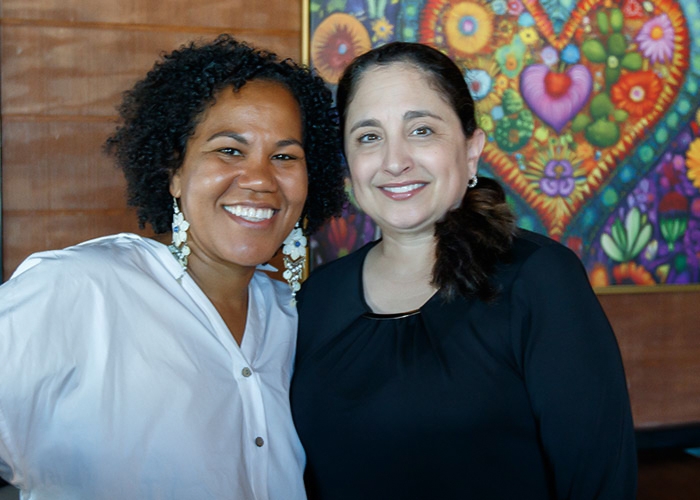
“I hope that after taking the course, RIC faculty and staff will have a better understanding of Hispanic students,” says Tejada.
Ramirez agrees: “Having faculty and staff learn Spanish is a way to give them a direct experience of what it’s like to learn a language. They get to experience that feeling of vulnerability, that feeling of struggling to find the words to say basic things. This is something our multilingual students experience every day when learning English.”
Those who take this course are not going to be fluent by the end of the course, but Ramirez’s hope is that they will have a different relationship with the language.
This initiative is part of other efforts by the Department of Modern Languages to connect language with community:
• The department sponsors conversation circles in Spanish and Portuguese during the academic year, which are open to the entire RIC community.
• The department has expanded student internship opportunities both on and off campus for language majors and minors. Internships take place in schools, community clinics and nonprofit organizations.
• A professional career series was created called Modern Language Conversations, where graduates come to share their job experiences and connect with current students.
• And an engagement initiative was created called Building a Community of Language Lovers, where students share their academic work with peers and faculty.
“All of these initiatives are to connect language with community,” says Ramirez. “That is the framework of everything we do. When you see people recognizing the value of language, it’s pretty exciting. In that way, our department is fulfilling its mission on campus.”
By 2050 the United States is projected to become the largest Spanish-speaking nation in the world.