
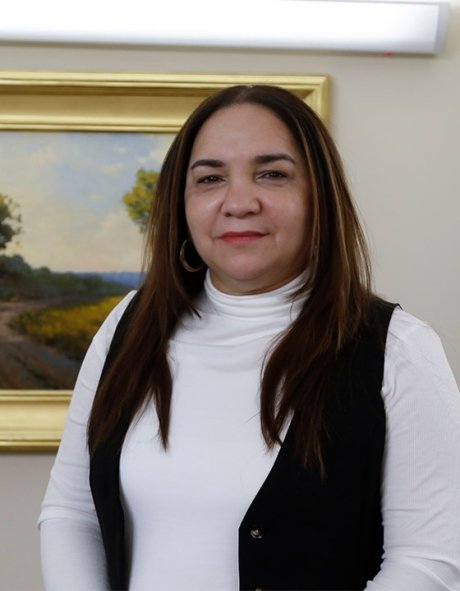
“I’m back in my element. I’m immensely grateful to RIC for letting me return to my roots,” says Hernández.
Cesarina Hernández ’21 M.A.T. was born in the Dominican Republic into a family of teachers. She was raised among notebooks, pedagogical advice and the example set by her mother and father, both teachers and dedicated to education. Although teaching had always been present in her home, her journey started with a different calling, a career in medicine.
Her story, marked by emigration, reinvention and resiliency, shows that starting over is not a failure but an opportunity. It illustrates that professional paths can take unexpected turns, yet they are never fully closed. Today, she teaches Spanish at Blackstone Valley Prep High School and she is an anatomy and physiology lab instructor at Rhode Island College.
Hernández first arrived in the United States in 1982, at age 16. She finished high school and, following her father’s advice, chose to return to her homeland to study medicine, as it would be cheaper, quicker and more accessible than trying to establish herself as a foreign doctor in the United States.
Five years later, she became a general practitioner, and for nearly two decades, she practiced medicine in the Dominican Republic. “I specialized in clinical nutrition and hospital administration,” she says. “I worked in health administration for the government, supervising hospitals and eventually managing one.” During that time, she also got married and had three children.
Eleven years ago, Hernández decided to return to the United States with her entire family. This was a difficult transition because in her home country, she had built a career, a reputation and a professional identity. Upon arrival, she faced the harsh reality of foreign-born physicians. She would have to take the required exams, obtain certifications and licensures, which is a costly and demanding process, “impossible for someone who had to work and support a family,” she says.
“The hardest blow was accepting that I wasn’t going to be able to practice medicine here,” says Hernández. She felt grief, frustration and bewilderment. However, she did have previous experience in teaching. She had taught English for medical purposes before becoming a doctor.
In 2017 Hernández began working as a substitute teacher for Providence Schools, gaining experience in the American education system and working with students from different cultural backgrounds.
“At first, it was tough. I was starting from scratch,” she says. “In my country, I managed hospitals, and here I was in the classroom with teenagers who needed overall guidance.”
A few years later, Hernández applied for a formal position as a Spanish teacher. Once accepted, she began the teaching certification process, which involved enrolling in the M.A.T. program in world languages education at Rhode Island College.
“My teaching skills were shaped at Rhode Island College,” she says. “I learned about instruction, about assessment and proficiency processes and how to set objectives. I had excellent professors, especially Professor Papa and my literature professors, Marjorie Roemer and Eliani Basile, who inspired me to resume my reading passion.”
Her time at Rhode Island College not only transformed her as an educator but also restored something she believed she had lost, the conviction that her medical experience still had value in the United States. Gradually, she realized that the classroom offered her peace, joy and a place to fully engage her intellectual abilities.
In December 2024, Hernández applied for a teaching position as an anatomy and physiology lab instructor at Rhode Island College. By January 2025, she was standing before a room of future nurses and healthcare professionals.
“I felt like life was giving me back a part of myself,” she says. “I’m back in my element. It’s like revisiting my past in medicine. I’m immensely grateful to RIC for letting me return to my roots.”
Today, Hernández moves easily between high school and college classrooms, between Spanish and science, between her past as a physician and her present as an educator, uniting her two passions: language and science.