
Plastic is Everywhere – Including in You
Microplastics permeate our environment. We inhale them in the air, ingest them in our food and absorb them through our skin. They travel through our bloodstream and settle throughout our body. They’re in our bones and brain, semen and placenta, breast milk and meconium (a newborn’s first stool).
The reality is that plastics don’t degrade, they don’t disappear, they just fragment into tiny pieces until you can’t see them. They become microplastics and even smaller nanoplastics that can enter our cells.
This summer RIC Professor of Biology Daniel Hewins is working with a social science team made up of two undergraduate students and the Woonasquatucket River Watershed Council (WRWC) to learn from and educate the public about the impact of microplastics.
Hewins is one of many experts involved in a fairly new EPSCoR project called The Socio-Ecological Impact of Microplastic in Coastal Ecosystems. Grant-funded, this project is led by URI Associate Professor Daniel Roxbury and includes a consortium of universities as well as faculty from Rhode Island College.” (See: RIC Partners with URI on $7M Research Grant.)
Together, these researchers are examining the socio-ecological impact of microplastics on Rhode Island’s coastal ecosystems.
“My work on this project is to connect the science to the broader community,” says Hewins. “It isn’t science-related research that I typically do. At its core, this work is community engagement and community outreach.”
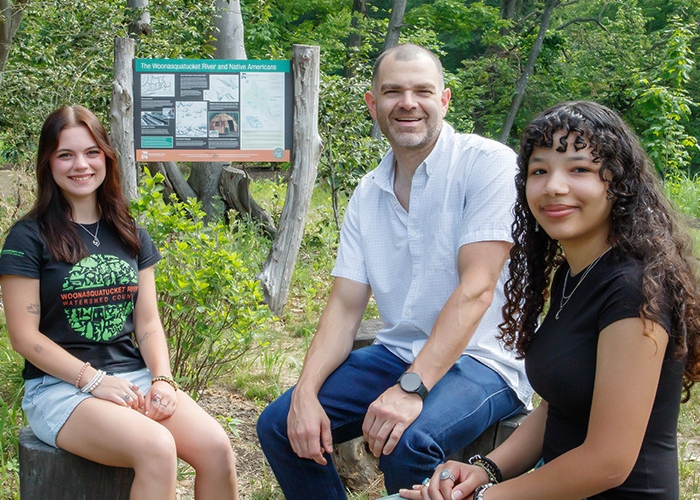
Elizabeth Turbi, a biology major, and Judy LaRose, a double major in environmental studies and anthropology, are his research assistants for the summer. Together, the team will focus on engaging with communities along the Woonasquatucket River Greenway.
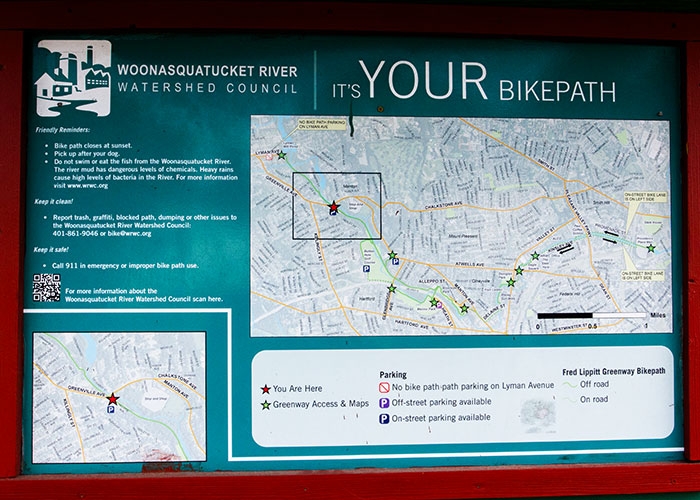
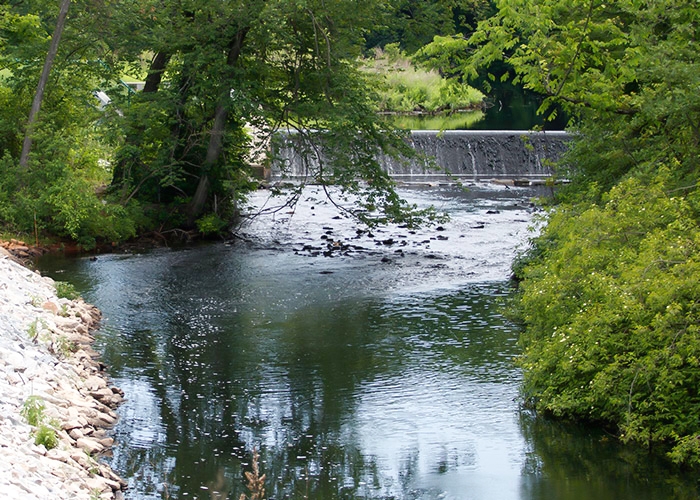
At its mouth, the Woonasquatucket River joins the Providence River, which empties into Narragansett Bay. Hewins’ team may go down to Narragansett Bay and talk to the fishermen who work on the bay to get their perceptions of microplastics. They may go into the Olneyville community and try to understand the average community member’s perceptions of microplastics.
Turbi will be working with two of WRWC’s Spanish-language environmental programs – Nuevas Voces and Nuestros Bosques.
“If you’re working in a community, I think it’s very important that you understand that community, that you have some experience with that community,” says Hewins. “Elizabeth brings life experience [with the Spanish-speaking community] to the project as well as a strong background in biology. Too often scientists go into communities and try to educate them without understanding them. We’re taking the approach of understanding and listening. We think it will help build a stronger line of communication and ultimately better outcomes.”
“Judy is interested in K-6 education,” he says. “She’ll be working in various settings with younger children. Her strengths lie in her leadership. She’s an advocate for foster youth and she serves on Student Community Government and the RIC Environmental Club. She has also had research and capstone experience in anthropology that prepared her well for this work.”
“In talking to K-6 children, we might ask questions like, ‘What do you know about this water bottle? Where does it come from and where does it end up?’ For the adults, our questions might be ‘How often do you think about plastics? What do you know about the potential for plastics to harm you and your family or to affect your food?’ I think we’ll be surprised by the answers and be able to learn a lot from them,” he says.
Hewins’ community partner, the WRWC, will help him develop surveys and an educational curriculum. He commends the many projects the WRWC has done over the years with local communities on environmental issues.
By the end of the summer, Hewins hopes to get a baseline of the community’s perception of microplastics. Eventually he would like to work with the WRWC to integrate microplastics and plastic pollution into some of their existing programming.
In reflecting on his research career, Hewins admits that environmental studies is actually a new focus for him. In the past, he primarily centered his research on science. About four years ago, when he began teaching the “Introduction to Environmental Studies” course, he experienced what he calls “a mid-career renaissance.”
“I was inspired and captivated by the environmental studies students,” he says. “They demonstrated a sincere and authentic desire to change their lives and the lives of the people in their communities. They would ask me to invite guests to class to supplement what they were learning or to learn more.
“We had lawyers come in from the Department of Environmental Management who were suing companies on behalf of communities in South Providence. We had environmental officers come in and talk to us about cases they had investigated. We had people from the Rhode Island Resource Recovery Corporation come in and talk about the technologies they use to sort and recycle and the economics of recycling.
“This was all catalyzed by the engagement and interest of the students, who showed an amazing investment in their own education, growth, development and career.”
Hewins says his eyes were opened to the work going on in local communities around environmental issues. Now he splits his research time between science and the more liberal-arts-oriented field of environmental studies. He is particularly passionate about the impact of microplastics.
“These particles are everywhere,” he says, “yet they’re very difficult to see. They’re in the soil, the water, the air and in our own tissue. I’m concerned and passionate about this because of how systemic it is and by the fact that it is totally human created. Perhaps we’ll eventually shift our need away from plastics like we did with asbestos.” But the work involved in doing so is immense.
As a biologist, Hewins knows that “nature always wins in the end.” “Everything we create can be taken back,” he says.
Learn more about RIC’s B.A. in environmental studies program.