
More Than Words: The Challenges of Communication Across Cultures
A word familiar to a Dominican may be unfamiliar to someone from Colombia, while an expression common in Brazil may not resonate with someone from Cape Verde. Differences in vocabulary, accents, expressions and cultural references can create unexpected barriers, even among people who speak the same language.
For translators and interpreters, the challenge goes beyond finding the right word; it is about communicating meaning clearly and in a way that makes sense to the people receiving it. This is especially important for healthcare, legal services, schools and government programs, where misunderstandings can make it harder to access essential services.
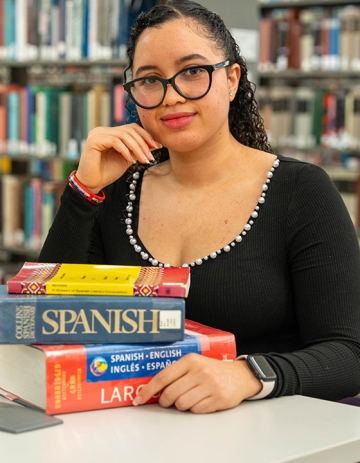
For Elianny Duarte Salcedo, a Rhode Island College senior studying modern languages with a concentration in Spanish and a minor in education, that lesson became clear during an internship with the wellness department at Progreso Latino in Central Falls. There, she helped members of the Spanish-speaking community navigate appointments and other services.
During her internship, Duarte interpreted at a seminar with Brown University instructors. The experience changed how she understood language and showed her that speaking two languages does not automatically make someone an interpreter or translator.
“You aren’t simply interpreting/translating a word from one language to another,” Duarte says. “You are interpreting emotions and culture. You are interpreting a clear message.”
One Language, Many Worlds and Meanings
Silvia Oliveira, director of Portuguese Studies in the Department of Modern Languages at Rhode Island College, sees the same challenge.
“Being bilingual and being a bilingual translator/interpreter are two different things,” she says.
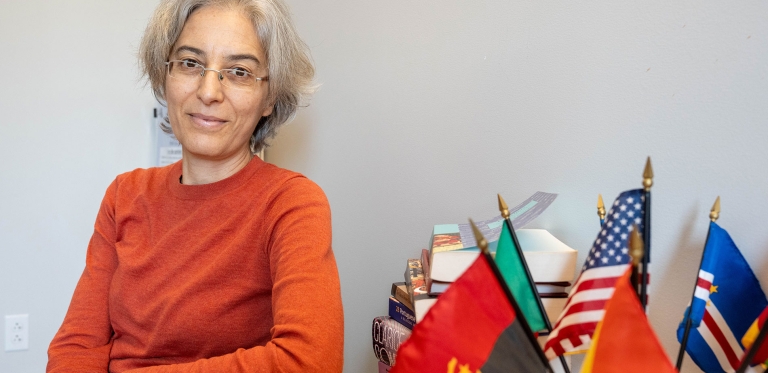
For her, language is inseparable from the people who speak it. Culture, history, geography and lived experience all shape communication.
“People who speak the same language may not share the same vocabulary, accent, expressions or cultural references,” says Oliveira. “Individuals who are not exposed to U.S. English spoken in the South or the Appalachia are quick to state that they ‘can’t understand them’; and if we add lack of cultural literacy about those peoples and contexts, then communication can break down.”
The issue is not always a lack of language knowledge. Sometimes they may speak a different variety of the language. When communicating with broad audiences, translators and interpreters may need to choose words that are widely understood rather than vocabulary specific to their own community.
For Duarte, that means setting aside the Spanish she naturally speaks as a Dominican and choosing a vocabulary that a wider audience can understand.
“When I am interpreting, I have to forget my thoughts and simply focus on the present to communicate the speaker’s intended meaning,” she says. “Concentration is especially important while interpreting. When there are different speakers, each with different accents and speaking styles, the challenge is to listen, process and communicate continuously.”
Idioms show why translation cannot always be literal. Oliveira recalls a multicultural conversation involving the German expression “donkey bridge,” which refers to something that connects one point of understanding to another.
“When translated literally into English, however, the result became confusing. We were not talking about donkeys, or about bridges,” she says. “The problem is not vocabulary. It’s history. It’s context. It’s culture.”
“The goal is to make that communication feel natural,” says Duarte. “I want to transmit the message as clearly as possible. I don’t want to sound like a robot.”
The Expertise Behind Effective Communication
Fluency in two languages does not necessarily prepare someone to interpret in a courtroom, medical setting or classroom. Translators and interpreters need specialized training and cultural knowledge.
“We need lived experience,” Oliveira says. “We need to be basically bilingual and bicultural in two languages.”
Duarte says her classroom experience at Rhode Island College helped prepare her for the demands of interpreting. Exercises with Professor David Ramirez gave her techniques she later relied on during her internship.
“I remembered all those techniques to focus and not distract myself visually, to turn off all my senses and simply use my hearing, to interpret not words, but messages,” she says.
Oliveira agrees that language education must go beyond vocabulary and grammar.
“The goal is not simply to teach students another language, but to help them understand how that language works in the real world,” she says. “Professional jargon does not come naturally simply because they are bilingual. Translation and interpretation are specialized.”
For Duarte, an interpreter is “the bridge that connects those two people.”
For Oliveira, that bridge becomes especially important when a message must reach people from different linguistic backgrounds.
“The more we listen to different varieties and learn about the cultures behind them, the better prepared we are to communicate across differences,” she says. “So listen widely and learn broadly.”
Learn more about RIC’s Modern Languages B.A. program.