
A Couple’s Journey Through RIC’s Medical Imaging Program
Medical imaging students Nicole and Jared Hughes met on a shuttle to class.
“He just came over and sat next to me,” she says.
“I sat next to her because she was beautiful,” he says.
A two-time RIC graduate, Jared Hughes, age 33, earned his B.S. in biology in 2015 and his B.S. in medical imaging in 2018.
Nicole (Proulx) Hughes, 31, spent three years in URI’s nursing program before transferring to RIC’s medical imaging program. She, too, earned her B.S. in medical imaging in 2018.
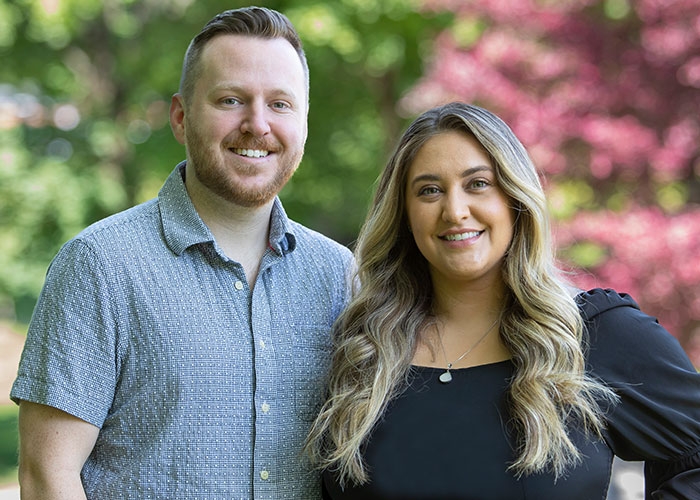
Today, they are MRI technologists who use imaging technology to create pictures of the inside of the body. These images help physicians diagnose, monitor and treat diseases and medical conditions. The Hughes work at hospitals in Providence and Boston. They also realize they beat the odds to get there.
“Out of 60 or 70 applicants, only nine students were admitted into the medical imaging program when we applied,” Jared says.
He notes that applicants are required to have a minimum GPA of 2.7, a minimum grade of C in their prerequisite courses, score in the 60th percentile on their entrance exam, submit an essay and score well on their personal interview.
“I think it was the interview that got us in,” he says. “It takes a certain kind of personality to work in the medical field. At the end of the day, it’s all about patient care. If that’s not your strong suit, then it might not be the field for you.”
“A lot of what we do is calm people down,” Nicole says. “People are coming in really sick and really upset. Our job is to convince them to take an exam that they don’t want to take, to produce results that they don’t want to see. We have a duty to keep it together, to make them feel comfortable.”
“Our imaging teacher, Randy Paquette, said it best, which I tell students now,” says Jared. “Nobody is getting an MRI because they want to. Nobody is there because they want to be there. These are people in their worst physical and mental states. You have to be the rock that helps get them through the exam.”
“I think RIC has the best imaging program around,” he adds. “In our jobs, we work with a lot of graduates from other imaging programs. Rhode Island College students are easily the most prepared.”
RIC offers the B.S. in medical imaging program in partnership with Brown University Health’s School of Medical Imaging. All of the courses are RIC courses, taught by RIC adjunct faculty; however, students take the shuttle to Brown University’s School of Medical Imaging located on Prairie Avenue for classes.
For the first two years, students take gen ed and prerequisite courses in anatomy and physiology, chemistry, physics and math, along with a one-credit Orientation to Medical Imaging course. In their junior year, they officially apply to the medical imaging program.
Once admitted, students choose from one of four concentrations:
Radiography, also known as radiologic technology, which uses X-rays or similar ionizing radiation to capture detailed images of various body structures, including bones and soft tissues.
Nuclear medicine technology, which is crucial for early diagnosis of diseases, as it can detect abnormalities before they are visible on other imaging tests. Technologists prepare and inject patients with small amounts of radioactive material to create detailed functional images of organs.
Magnetic resonance imaging (MRI) technology, a non-invasive form of imaging that uses powerful magnets and radio waves to create 3-D images of soft tissues like the brain, spinal cord, organs, muscles and blood vessels.
And diagnostic medical sonography, also known as ultrasound, which works with high-frequency sound waves to create images of soft tissue.
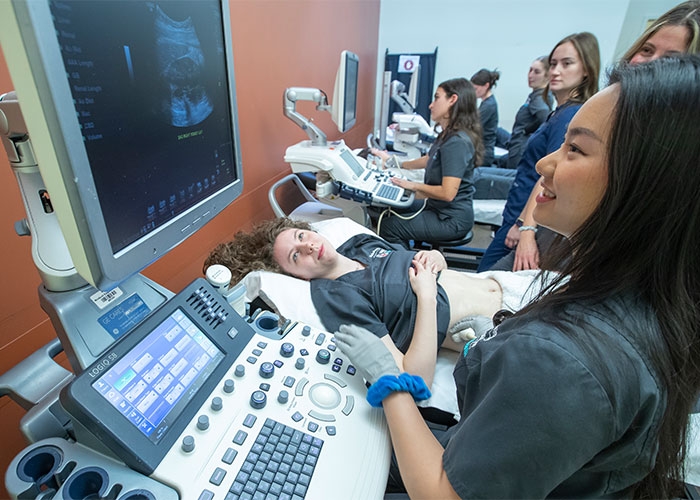
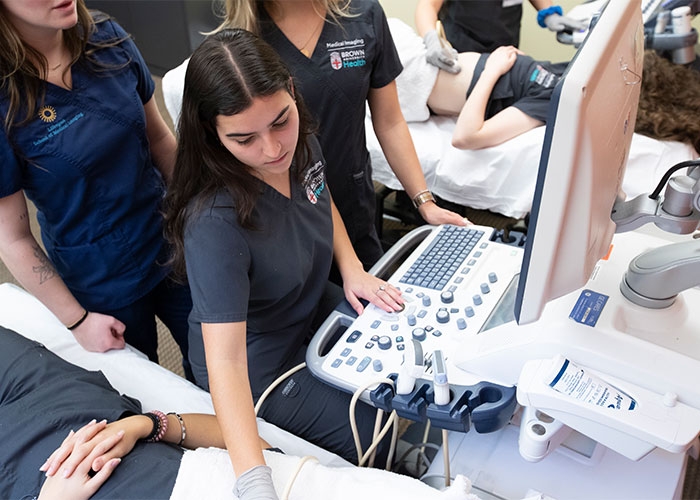
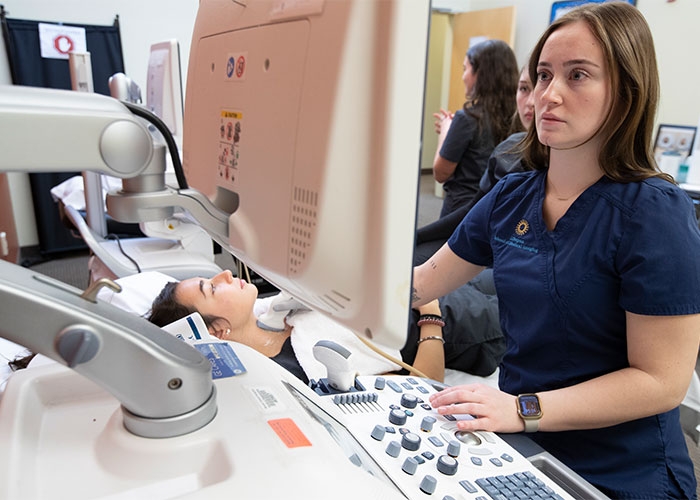
No matter the specialty, medical imaging technologists are in great demand in the United States, driven by an aging population, a retiring workforce and advancements in technology. The U.S. Bureau of Labor Statistics projects that there will be tens of thousands of vacancies annually over the next decade.
At RIC, students are assigned a concentration in the first semester of their junior year and take intro courses in that concentration.
“First semester is five days of classes and six-hour days,” Nicole says. “It’s like having a full-time job.”
“I would see Nicole during study groups with other classmates,” Jared says. “We became good friends, but most of our attention was taken up with school.”
Second semester consists of clinicals. That’s when students start seeing patients, supervised by hospital employees who are also adjunct instructors in the program. Clinicals are three days a week, along with two days of classes.
In their third semester, students have four days of clinicals (working eight-hour days at either a hospital or an outpatient site) and one day of class. Jared and Nicole did their clinicals at Rhode Island Hospital, Rhode Island Medical Imaging and The Miriam Hospital.
“To be board-certified, you have to complete a certain amount of clinical hours,” Jared explains. “RIC students hit that quota well before they finish their degree, which is why they come to the job so well prepared. They’ve had a ton of clinical time.”
“As students engage in their clinicals, they’re rotating through a number of different locations,” says program faculty advisor, Associate Professor Eric Hall. “Every rotation is essentially a job interview. As they go about their clinicals, they’re being observed and could possibly be offered a job at that facility.”
RIC students are known for getting job placements before they graduate and before passing the certification exam. Jared and Nicole were among those who did. Job placements for RIC graduates is over 98 percent, and the student pass rate on the certification exam is approaching 100 percent.
“That’s not true of every medical imaging program,” Hall says. “There are students who graduated from other programs who struggled with the certification exam. They come to us to redo their entire program here and end up passing the exam.”
After graduation, Jared and Nicole worked in the same MRI unit at Rhode Island Hospital.
“We spent a lot of time talking to each other when we were at the hospital and we’d do activities together outside of work,” Nicole says. “He’s a great listener; someone I’m always learning from.”
Eventually they bought a house together in 2020, they were engaged in 2022 and married in 2024.
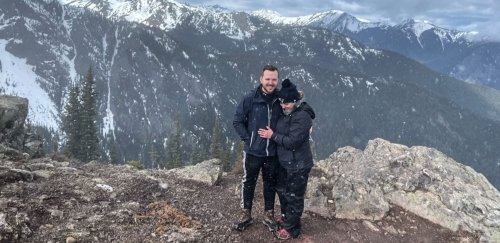
“I proposed on top of Mt. Townsend in Washington state,” Jared says. “We were on vacation, visiting her cousin. Her cousin told her it would be an easy hike up the mountain. It wasn’t an easy hike. We had to wear snow spikes on our shoes. It was about four-and-a-half hours to the top. She quit about 45 times on the way up.”
They’ve been climbing professional mountains ever since and supporting each other through the challenges. Nicole moved two years ago to Brigham and Women’s Faulkner Hospital in Boston, while Jared has stayed with Rhode Island Hospital.
“I see adults and children with cancer,” he says, “people with strokes, a lot of intensive care patients, people coming in from bad accidents with low-level trauma. If you work at Rhode Island Hospital, you can work anywhere because you get such a wide variety of patients. It’s a difficult environment – high stress, short staffed. But at the end of the day, it’s all about patient care. It’s a great career.”
It’s even better when you get to share it with your best friend and life partner.
Learn more about the B.S. in medical imaging at RIC.