
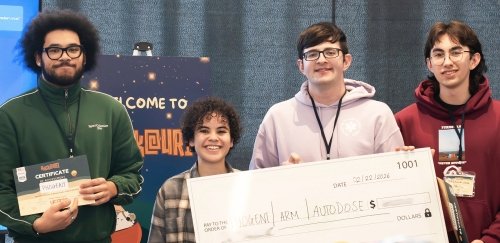
Their AI-powered app propelled them to victory.
Within the span of 24 hours, a team of four RIC students beat out their competitors at URI’s first hack-a-thon held Feb. 21-22. The event drew more than 100 student participants from colleges and universities across New England. There were 39 teams and nine winners (one winner per track).
As winners of the artificial intelligence (AI) startup track, the RIC team took home $3,000 and earned an all-expenses-paid trip later this year to participate in a hack-a-thon at the United Nations in New York City.
Team members are Edward Tavarez, a senior double majoring in computer science and cybersecurity; Sonya Cheteyan, a senior double majoring in computer science and AI; Nathan Fowler, a senior double majoring in computer and data science; and Lucas Webber, a junior majoring in computer science.
Their challenge was to apply AI to real problems through strong execution, technical depth and experimentation. The students answered that call by developing a phone app, Phogent, that allows users who are deaf, autistic or beset by phone anxiety to make and receive calls in real time via a text conversation.
The RIC team first divvied up their roles on the project. Webber and Tavarez pieced together the front-end work, using code to create the look and style of the app. Cheteyan and Fowler homed in on the AI aspects of creating Phogent.
Initially, Cheteyan says the project got off to a rocky start.
“We were thinking it wasn’t going to be feasible,” she says. “That is, until Lucas (Webber) had a eureka moment regarding debugging issues on the app.”
After that breakthrough, she says, she knew the app had a good chance to win.
“One of the hack-a-thon mentors has an auditory processing disorder, which makes phone conversations difficult to interpret,” Cheteyan says. “He said our app was a really good idea for someone like him. His perspective gave us hope that this was a useful project.”
The project went through three rounds of judging before being declared a winner.
“The experience of participating in the hack-a-thon was overwhelming,” says Webber. “Since it was our first time, we figured there would be people more experienced than us. During the preliminary judging, we saw many projects that were well done. It’s kind of crazy to reflect and know that we came out on top.”
“I like that our app is something that can be used in the real world,” he adds. “Our goal now is to make a public version and perhaps partner with the Sherlock Center [on Disabilities], which is located on RIC’s campus, to test it out on the community they serve.”
Cheteyan says she appreciated that all the team members were equally dedicated.
“We were motivated and had positive energy,” she says. “To me, that's better than participating in the hack-a-thon by myself. Sometimes your brain can’t process, and having a team to think through strategies helps.”
RIC’s AI program director, and Associate Professor Timothy Henry, was the impetus behind them entering the hack-a-thon. He was thrilled by the outcome.
“This is a remarkable achievement,” Henry says. “What makes their winning app especially impressive is that they didn't just build something technically sophisticated. They identified a real problem affecting people with hearing, speech and communication challenges and engineered a thoughtful solution. They exemplify the kind of human-centered, applied thinking we work to cultivate across our programs at RIC.”