
A Quintessentially American Composer
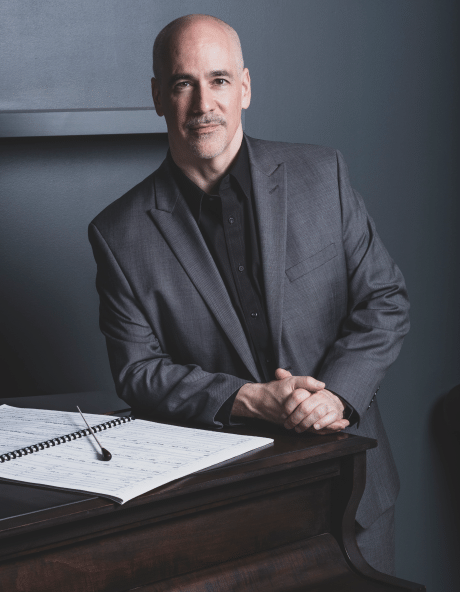
Inside his 350-square-foot home studio tricked out with speakers, keyboards, computers, musical scores, and assorted tech gadgets, Peter Boyer ’91 spends endless hours crafting his next classical masterpiece.
Some might say that the Grammy-nominated Boyer represents the next generation of iconic composers like Aaron Copland and Leonard Bernstein, whose photos adorn Boyer’s studio walls in Altadena, a Los Angeles suburb.
“I’ve spent so much of my life studying the music of composers like Copland, Bernstein, John Williams, Samuel Barber and others,” he says. “I don’t think my music sounds exactly like any of those folks, but it is informed by them. Many people have said my work has an American sound, and I think I would agree with that. But it isn’t something I consciously set out to do; it just simply happened.”
And everything started happening for the preeminent composer while he was an ambitious 17-year-old student at Rhode Island College.
“That was a very important time for me,” he recalls. “I was learning about Mozart and other composers and decided to write a requiem mass for my late grandmother, who bought my first piano. It was an enormous project that took over the span of three years to develop.”
Today, Boyer’s compositions have been performed by more than 300 orchestras around the world. Two of his latest creations are “American Mosaic” and “A Hundred Years On.” Over the last few years, he’s been holed up in his studio to create these major American-themed pieces.
“These projects represent two of the biggest commissions of my career, and they came at the same time, both related to ‘America 250,’” Boyer says. “It was a balancing act and a challenge to bounce back and forth between the two, but I made it work. We’re talking about thousands of bars of music.”
“A Hundred Years On,” a 46-minute oratorio, documents a day at Philadelphia’s 1876 Centennial Exposition (considered to be the nation’s first official World’s Fair) performed by the Philadelphia Orchestra, The Crossing choir and five vocal soloists. Boyer was commissioned by the Highmark Mann Center for the Performing Arts to celebrate its 50th anniversary. The work features Boyer’s score and sets to music a 27-page libretto by Grammy and Pulitzer Prize-winning librettist Mark Campbell.
“My job was to arrange Mark’s words to fit the narrative for five singers, a choir and the orchestra,” Boyer says. “It was a massive task.”
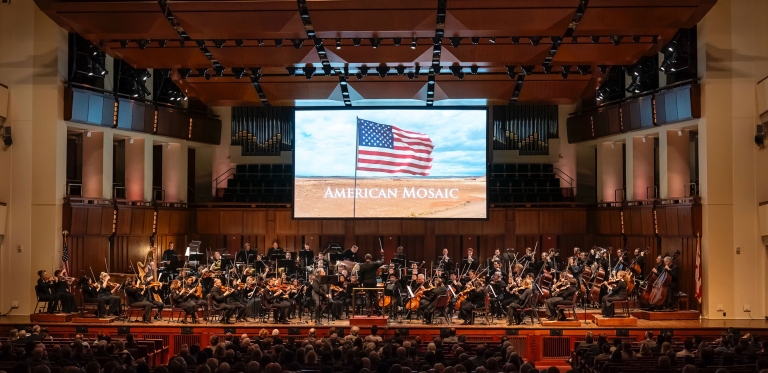
Simultaneously, a consortium of seven orchestras, including five of the nation’s most prominent, jointly commissioned Boyer to create “American Mosaic.” He teamed up with photographer Joe Sohm on the multimedia project, a 33-minute piece that features 11 sections spotlighting Boyer’s music, Sohm’s photography and video, and selected quotes from American history narrated by acclaimed actors such as Martin Sheen and Gary Sinise.
Sohm’s imagery has been published more than a million times in publications such as National Geographic and the New York Times and on NBC and Fox. His work was also featured during a “Concert for America” attended by President George W. Bush.
“I gave Joe about four hours of my recorded music,” Boyer recalls. “And he listened, made selections, and coordinated the music with an array of gorgeous photos and videos he’s taken all over the country during his more than 40-year career. Over the course of several months, we created sections for the piece that focused on American agriculture, transportation, military, cityscapes, towns and people. Ultimately, we adapted a lot of my existing music into something entirely new.”
“American Mosaic” premiered in February at the Kennedy Center for the Performing Arts in Washington, D.C. with three performances by the National Symphony Orchestra. Three more performances followed in March by the Cincinnati Pops Orchestra, narrated by Sheen.
Additional performances followed by the Detroit Symphony, Nashville Symphony, Pacific Symphony, Des Moines Symphony, and Williamsburg Symphony. Actor John Goodman will narrate the work with the St. Louis Symphony in November.
The piece was also recorded at the Sony Scoring Stage in Los Angeles, and adapted into a short film, with narration by Sheen. The film is set to premiere at the Ojai Film Festival in November.
“It’s been extremely exciting to see the reception for the live performances of this project,” Boyer says. “There is an energy that you can feel in the audience. And to know that they’re completely engaged with something you helped create is satisfying and even surreal.”
RIC Adjunct Professor of Music Stephen Martorella, whom Boyer cites as one his biggest mentors, says it’s similarly surreal to see the success of his former student, but he isn’t surprised.
“While at RIC, Peter showed energy, inquisitiveness, discipline and thoroughness in his work,” Martorella says. “His goals and vision never diminished.”
Boyer sought Martorella’s counsel while putting the finishing touches on one of his first major works, the Grammy-nominated “Ellis Island: The Dream of America.”
“I remember a conversation we had just after the 9/11 attack against the World Trade Center,” Martorella says. “I had suggested then that his work would in many ways be prophetic and provide healing for a wounded nation. The success and poignancy of ‘Ellis Island’ in the following year, and its continued success, tells Peter’s story more eloquently than any words of mine.”
“Ellis Island” has gone on to become one of the most frequently programmed works written in the 21st century by an American composer.
“In 2027, it will turn 25 years old, and by that time, it will have been performed more than 350 times by orchestras,” Boyer says. “That’s a rare thing to happen.”
Martorella says he’s especially pleased to see Boyer’s work and vision grow and mature.
“He’s making such a solid and substantial contribution to American symphonic music today,” he says.
Boyer’s advice for aspiring composers at RIC is to put in the work to manifest their dreams.
“Passion is the most important thing,” he says. “If you combine that with talent, perseverance and the curiosity to never be satisfied, you’ll be successful. Additionally, when thinking back to my days at RIC, I always sought advice and mentorship from people who knew a lot more than I did. That was certainly helpful.”
Lead photo above is courtesy of Dario Acosta