
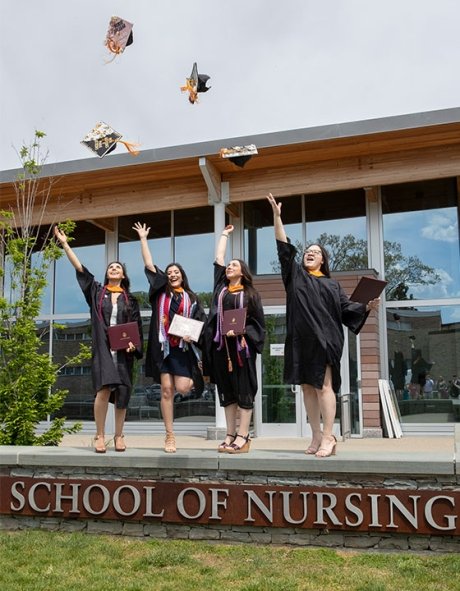
“This program is an opportunity to support students with the challenges of nursing school.”
When nursing students face academic challenges, having the right support can make a huge difference. At Rhode Island College’s Zvart Onanian School of Nursing, the Student Success Coaching Program helps students stay on track by providing individualized guidance and support. Launched during Spring Semester 2025, the program was created to identify students who may benefit from additional help before academic setbacks become permanent barriers.
“The program is intended for students who have failed or withdrawn from a course,” says Laura Baron, the program’s coordinator. “Those who are granted the opportunity for readmission, which is not guaranteed, are required to participate. We want to capture those students early and give them the support they need to be successful.”
Once applications are submitted, Baron reviews the students’ academic records and assigns each student to a faculty coach who can provide individualized support. Students and coaches meet weekly or biweekly throughout the semester to discuss challenges, set academic and personal goals, and develop strategies, such as improving their study schedules, learning exam preparation techniques or working with tutors. The meetings are designed to be flexible and conversational, giving students a space to talk openly about the academic and personal pressures of nursing school.
“Nursing schedules can be complex for faculty and students, so availability plays an important role when matching students with coaches,” says Baron. “We want students to feel like they have someone in their corner, someone they can go to if they’re struggling with course content, study strategies or even the personal stress of nursing school. Some weeks, students need help with academics. Other weeks, they might just need someone to talk to.”
Faculty coaches are well prepared for the role because they are directly involved in the nursing curriculum and understand the demands of the program and the types of questions students must master as they prepare for licensing exams.
In addition to academic guidance, coaches often connect students with campus resources, such as the Counseling Center, tutoring services and financial assistance programs. In some cases, coaches help students pursue professional opportunities.
“Feedback from participants has been overwhelmingly positive,” says Baron. “Many students report developing better study habits, staying more organized and feeling more confident in their abilities. One common response is that students wish they had had access to the program earlier in their academic journey.”
“The coaching program has significantly improved my confidence,” says Erika DaCruz, a senior nursing student. “I failed one of my nursing classes, and despite feeling discouraged, my coach’s encouragement and connection really helped me throughout that whole semester.”
“Including time management, my mentor, who is also a RIC alumna, helped me immensely with various study tips and resources that I have also brought into my last semester while studying for our standardized practice test,” says DaCruz. “Having someone who understands what you're going through is the beauty and best part of the program.”
For junior Mackenzie Medeiros, the coaching program helped shift her mindset and rebuild her confidence.
“Nursing school can be incredibly challenging, and having someone who genuinely wants to support you and see you succeed makes a huge difference,” she says. “My coach, Dr. Connelly, gave me a safe space to talk about what I was struggling with and how overwhelmed I felt. She helped me look at things from a different perspective and worked with me on strategies for staying calm, improving time management and staying organized. I’m really grateful that the program exists because it provides support to students during moments when they might feel like giving up.”
The program’s first semester produced promising results. “Nine students participated in spring 2025 and eight of them successfully passed their nursing course,” says Baron. “One student ultimately changed her major after failing the course, but she will still graduate from RIC. Another student, despite passing, decided that nursing was not the right path for her and also changed her major. That’s still a success. If nursing isn’t the right path for someone, we want them to realize it early and find something they’re passionate about.”
Currently, seven students are enrolled in the program. “Our hope is to grow so that we can help more students earlier in the semester,” she says. “Currently, the number of participants depends largely on the availability of faculty coaches, who typically work with one or two students at a time to ensure meaningful support.”
Baron, who also serves as the simulation lab coordinator, works closely with students as they practice clinical skills and often sees firsthand when students are struggling. “I see students in the lab who need a little extra practice or guidance,” she says. “This program is an opportunity to support our students not just with skills but with the overall challenges of nursing school.”
Even after the semester-long coaching period ends, many students continue to stay in touch with their coaches to share updates or to ask for advice. “Recently, one of my former coaching students stopped me in the hallway to celebrate earning a high score on her first exam of the semester,” Baron says proudly.
“Moments like that demonstrate the true impact of the program,” she says. “It’s not just about helping students pass one class. It’s about giving them the confidence and the tools they need to keep moving forward.”
Learn more about RIC’s nursing programs.