
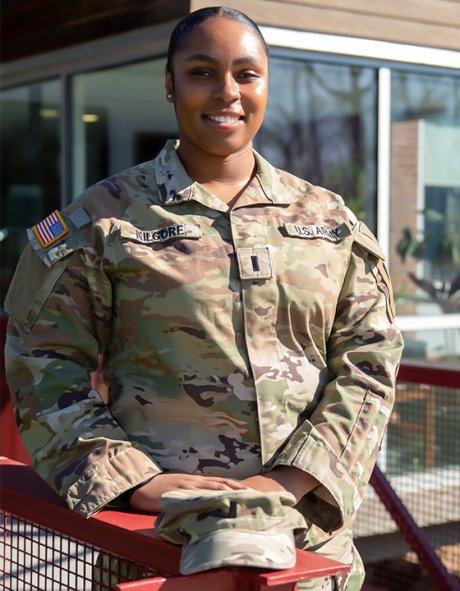
At 26, Nakena Kilgore exemplifies leadership, advocacy and community-driven change.
Nakena Kilgore, a Master of Social Work student at Rhode Island College, was recognized at the NASW 2025 awards ceremony for her leadership, advocacy and commitment to community —an achievement that reveals a journey shaped by service and personal growth.
Kilgore entered the M.S.W. program with a strong foundation in discipline and hands-on experience.
During her undergraduate studies in kinesiology at the University of Rhode Island, she was involved in the Sisterhood of P.I.N.K., a community centered on empowering women of color. She also participated in ROTC, which led her to enlist in the Army. Following graduation from URI, although she once envisioned a future in physical or occupational therapy, her path shifted while working as a case manager at a family agency. That experience introduced her to the impact and possibilities of social work.
“There, I met Rhode Island College M.S.W. students who encouraged me to apply to RIC. They saw that I really liked being a case manager, working therapeutically with families and family dynamics,” she says. “I guess I’ve always been in the field of helping people. I just didn’t know how I wanted to help.”
A year later, she enrolled in RIC’s M.S.W. program and clarity began to take shape through coursework, discussions and exposure to the field.
“Learning the values of social work really aligned with my personal values and how I want to advocate in the world,” she says. “Social work is extremely flexible. People think of social workers as just therapists or DCYF workers, but we are everywhere.”
Outside the classroom, Kilgore manages an intense schedule. She works as a unit secretary at Miriam Hospital; serves as a military police officer in the Rhode Island National Guard, where she holds a leadership role as a platoon leader responsible for more than 30 soldiers; and maintains a strong connection to her family and friends.
Professionally, she has developed a calm, steady presence, which she considers one of her greatest strengths.
“I believe other people make me better. When I see what others are doing and hear their viewpoints, it pushes me to grow,” she says. “No matter the crisis, I’m going to hear you out and we’re going to manage it together. It comes naturally because of what I’ve been learning.”
Kilgore’s journey has not gone unnoticed. In November 2025 she received the NASW award for her strength, service and solid commitment to her community. Surrounded by family and peers, Kilgore recalls tearing up during the speech. It was a culmination of years of hard work and a reminder that she had not reached this point unaccompanied.
“I did not do this alone,” she says. “This journey was definitely in support of my family, my friends and my professors, who pushed me along the way to help me get here. I’m extremely grateful for everyone in my circle.”
It was her practicum instructor, Assistant Professor of Social Work Megan Smith, who presented her with the award.
“Nakena has a tremendous amount of grit,” Smith says. “She manages a particularly full schedule and does so with grace. She always showed up to classes and events on time and was not only physically but mentally and emotionally present. During the program, it’s been great to see how she’s integrated the academic content with her unique way of being. She’s always been her true self, just with an ever-expanding skillset.”
According to Smith, Kilgore also embraces challenge and brings in contrasting viewpoints in a way that deepens dialogue and reflection.
One of those challenges was advocating for House Bill 266, legislation aimed at eliminating the exam requirement for entry-level clinical licensure. Elimination of this requirement would allow M.S.W. graduates to enter the workforce more quickly. It was a critical change amid a shortage of social workers.
Although initially intimidated, Kilgore says the experience became one of the most empowering moments of her graduate career.
“It was an introduction to advocacy, an empowering moment that affirmed my commitment to meaningful change,” she says, “and it was a success. The bill passed and will be in effect through 2030.”
Looking ahead, Kilgore hopes to begin her career in a hospital or community-based agency, where she can continue developing her clinical skills while staying engaged in policy and advocacy work. She is particularly interested in issues like environmental justice and systemic inequities affecting Providence communities.
Her long-term goals include becoming a licensed independent clinical social worker and eventually working as a military social worker, merging her dual passions for service and mental health.
“I am so excited to see what Nakena does as a social worker,” says Smith. “She is a versatile practitioner, both with respect to the populations she’d like to focus on and her level of practice. I could see her thrive in any number of settings, particularly in social work education as a field supervisor, instructor or both, because future students will gain a lot from her perspective and philosophy of practice.”
For Kilgore, her journey is far from over and the work ahead is not just about a profession but about responsibility to the community she serves and to the changes she wants to make.
“Social workers should be politicians, in a sense,” she says. “We want the betterment of communities. We want fair access to resources.”
Learn more about RIC’s M.S.W. Program