
Mgt. Students 1st in RIC History to Beat Out 99% of International Competitors
A team of five seniors who simulated the running of their own company for an entire semester beat out 99 percent of their competitors – that’s more than 15,000 international teams, including their classmates and Capsim computer-operated teams.
“Although past cohorts have performed well on the Capsim simulation,” says their professor, Jiyun Wu, “reaching the 99th percentile overall is unprecedented in all my years of teaching at RIC.”
This simulation was part of Wu’s MGT 461: Seminar in Strategic Management course. The key players were:
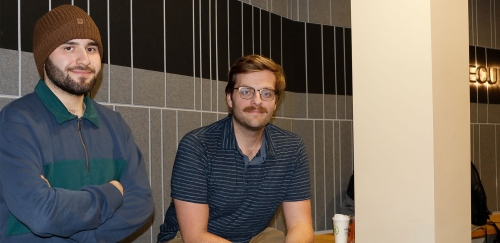
- CEO Brian Guertin (seated right in photo above) – competitive, driven, ambitious, with a sharp eye for detail.
- COO Ethan Nunziata (seated left in photo above) – equally competitive, confident, with an eye for the big picture.
- CFO Ashley Proulx – a critical thinker and excellent business report writer.
- CHRO Rosanni Toribio – an outside-the-box thinker.
- CIO Lourdes Vasquez – a back-to-basics thinker, focusing on the fundamentals.
“None of us were assigned these job titles per se,” says Nunziata. “Part of our strategy was not to leave anyone in charge. Instead, we all ran through decisions collectively. But if we were given titles in the real world, this is how we would have probably functioned, and it’s how Brian and I ended up functioning towards the end of the competition.”
Each week, their company was faced with complex business decisions in which there was no clear right answer (as was their competitors). Any decision they made could potentially bankrupt them or bring their profits to new heights.
RIC News sat down with Guertin and Nunziata – fierce competitors – to find out their winning strategy. The first question was posed to Ethan Nunziata, whose informal role as chief operating officer meant he often acted as the right-hand-man to Brian Guertin.
Ethan, what strengths would you say Brian brought to the game?
Ethan: He’s got great attention to details, he’s good with numbers, he’s good with forecasting and he’s good with projections, which is really important in this game.
[Forecasting involves predicting likely outcomes based on trends. Projections involve exploring “what-if” scenarios based on hypothetical goals.]
He also has the more in-depth knowledge, the really niche knowledge. It wasn’t that I was crazy far behind him, but I didn’t have it to the same degree. A lot of the times I’d check him because sometimes he’d get a little too ambitious or overthink certain decisions. That’s when I’d come in and offer a different perspective or just be there to help him think things through.
What were Ethan’s strengths?
Brian: His ability to think things through and see the bigger picture. That’s really helpful. There were a lot of times when I would get stuck on projections for one particular year, and he would often say what about next year? What about three years down the line? That was really helpful.
How did you both prepare for the competition?
Ethan: Brian read the simulation manual from front to back, which was really helpful. If we were in a tight spot, he knew where to look in the manual for help. I focused on the practice rounds. There are three practice rounds before the competition starts. I saw it as our chance to fail and learn from it. I pushed the group to try strategies that were more aggressive, so that if we ever got to a point in the game where we thought a more aggressive approach might be a viable strategy, we’d know how it was going to play out. Also the Capsim simulation has its own ChatGPT. I’d ask it different questions and give it different scenarios to learn what it might say about some of the niche areas we might come across.
Why was making decisions so precarious in this game?
Ethan: Part of how the simulation works is that when you’re making a decision, it’ll change the projections in your other departments in real time – the marketing department, production, finance, research and development, they’re all affected. So you have to be mindful of that when you’re tinkering with decisions.
The simulation is also a little tricky in that the customers’ needs and their wants change, but sometimes only very slightly, and it changes each round. They give you a price range that the customers want for your product and it’s always shifting. So you have to make sure you’re paying attention and revising pricing. There were a few years where our competitors didn’t properly adjust their price. They were slightly outside of the range, so we were able to gain more market share [percentage of total sales compared to rivals].
Did your company face any major challenges?
Ethan: There was a risky strategy that we were heavily considering. Throughout the entire week, we consulted different people – we talked to Professor Wu, we consulted outside professors, we looked at online resources, we emailed the Capsim support team, we referred back to the player’s manual. Everyone was doing their part to accumulate as much knowledge as they could so we could make the best educated decision. It was a very big moment for us. Ultimately, we decided against the strategy, which I think was the best course of action.
You beat out your classmates and the computer-operated team. You placed in the 99th percentile against the world’s teams. What helped you achieve top ranking?
Brian: Our ability to work together as a team. We only met in class once a week, but we talked in our group chat every day.
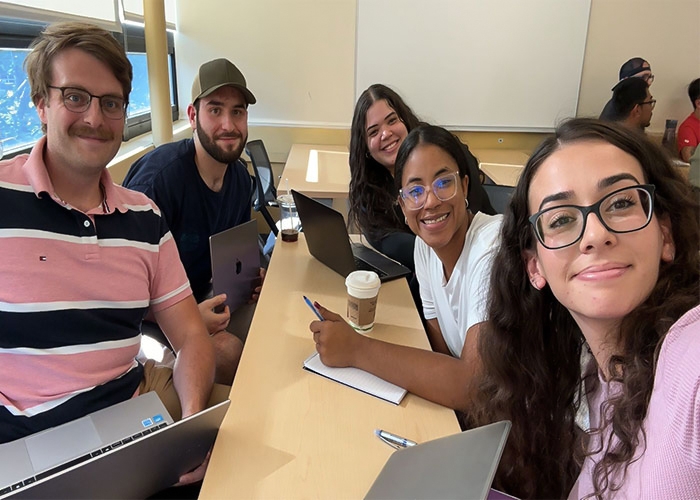
Ethan: Yeah, it was easily the most active group chat I’ve ever been in. If there was something we couldn’t articulate through group chat, we’d do Zoom meetings and share our screen and run through decisions that way. Capsim would process rounds at midnight and we’d be up at midnight, talking about the results afterwards.
I would also definitely say the forecasting of our group was the best and that’s the most important thing because everything plays off your forecast. Ironing that out and becoming really proficient in that was the single most important reason as to why we were successful. If your forecasting is off, it doesn’t matter what you do, everything else is going to be wrong.
Brian: In terms of forecasting, we had a best-case and worst-case scenario. We’d plan for the worst but we’d leave enough room for the best. It’s one thing to plan for the best and hit the best. It’s another thing to plan for the best and hit the worst. We got really good at knowing the range, and we kept ending up at the top of the range.
What did you learn from this competition?
Brian: The power of investing in your own company. We were able to see in real time, from week to week, the powerful effects of investing in your own people and how it can really help you achieve your goals.
Ethan: During those practice rounds, we were a little too caught up in what the other teams were doing; we were playing to them. But once we started the first round, we focused a lot more internally on building our company to scale.
Brian: And once we got ahead, we were able to look back and see the companies who were on our coattails and say this is what they’re trying to do, let’s try to block them and stay ahead of them. But definitely in those early rounds, we were focused on building up our own base.
How would you rate this course?
Ethan: It was very valuable. Professor Wu could see everything that was going on in everyone’s simulation. She hit a sweet spot of intervening when she needed to and allowing us to figure things out for ourselves. She was also very timely in responding to our emails. Sometimes we’d email her at nine at night and we’d still get a response from her.
Brian: Just knowing you have someone you can rely on if you need them, even if you don’t need them, is so crucial, especially when you’re making decisions. What stuck with me was that Professor Wu gave us real-world examples of different companies and the strategies they use that we could implement in our own simulation. Knowing that this simulation has real-world applications – being able to say Nike or Walmart operates like this – really put it into perspective when we were making decisions.
“I am truly proud of these students, who distinguished themselves among their peers around the globe. Another team in my class made impressive strides, as well, scoring above the 90th percentile in the final three rounds. I am happy to see how engaged they all were with this complex simulation.”
- Associate Professor Jiyun Wu
Learn more about RIC’s Management B.S. program.