
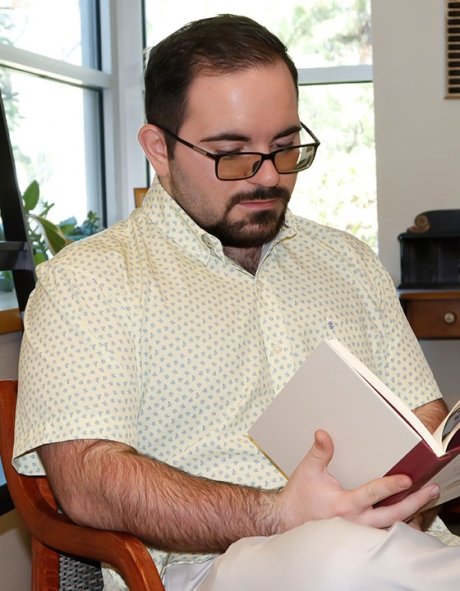
“I can’t say I was lonely, because I was surrounded by people, but I didn’t want to interact with them. It was a way to protect myself.”
“Justin Wahlers has overcome considerable barriers to find his path,” says RIC Professor of English Janet Johnson.
At age 24, he will be graduating this May from Rhode Island College with a B.A. in secondary education English. But his story didn’t begin here. It began at age seven when he and his brother were placed in foster care.
“My biological mother was great,” Wahlers explains. “It’s just that she was always in the hospital. She was too sick to take care of us. At first, foster care kept me and my brother together, but then they separated us.”
He recalls the first foster home without his brother: “It was awful,” he says, “but that’s because they expected me to know how to do things like make my bed and do laundry. Usually my brother did all that for me.
“The second home was a little nicer, just very strict rules like 8:00 bedtime. I had a big fear of the dark. At home I’d have the TV on to fall asleep, but that was a big no-no in that household. I coped with the dark by either hiding under my covers or crying myself to sleep.”
At age nine Wahlers was placed with Isabel and Helder. “I was their first foster child. It was a match made in heaven. They’re both Portuguese like me. I felt at peace knowing that we had a shared heritage,” he says.
“At first, I didn’t like telling them about myself or saying things like ‘I’m afraid of the dark,’ because it felt awful trying to explain it. But they just took it in stride. They were like, ‘That’s fine. If you want a nightlight we’ll get you a nightlight.’ Isabel’s a fantastic cook and Helder has a really big extended family who opened up to me right away,” he says.
Two other foster children soon joined him – Jackie Carroll, a graduate of RIC who was interviewed by RIC News two years ago, and her twin brother. “I call them my sister and brother. I think the word ‘family’ is relative. Blood is only a portion of the equation,” Wahlers says.
Though things were going well at home, Wahlers didn’t care to form friendships or even to do schoolwork. “I didn’t think there was any point,” he says. “Foster care has this weird thing where they would tell my foster parents that I’d probably only be in their home for six months. They’d say this right in front of me every time I moved to a new home.
“So, I thought, ‘Why am I going to bother to do schoolwork or make friends if I’m only going to be here for six months?’ I’d just shove my homework in my bookbag and go home and call it a day. If kids or teachers tried to talk to me, I’d either say nothing or I’d do a quick head nod or shake my head and call it a day. I can’t say I was lonely, because I was surrounded by people, but I didn’t want to interact with them. It was a way to protect myself.”
By age 13, when he realized that he’d be staying with Isabel and Helder for good, he thought, “Maybe now I can try to have a life. I can start living now.” However, Wahlers continued to shut out anyone outside the family.
A turning point came in his senior year in high school. “I had this phenomenal English teacher who introduced us to the book ‘The Catcher in the Rye.’ I immediately connected with the main character Holden Caulfield.”
“I loved Holden,” he says. “He was like a best friend because we shared many of the same traits. I closed myself off and he closed himself off. Granted, he did it differently, but it felt to me like finally there’s somebody out there who gets it.
“I would explain how similar Holden was to me to my English teacher,” he says. “For instance, Holden does this pacing thing like I do. I have ADD and either I’m pacing or I have a pen or pencil in my pocket that I fiddle with. It keeps my ADD in check. Holden barely ever lashes out in anger. I was like, ‘Yep, that’s what I do.’ Holden bites his tongue. I did that a lot, too.”
Because of this book, Wahlers began opening up and participating in class. It was like a key had unlocked the door to his cell. He could step out into life fully now. From then on, instead of avoiding connection, Wahlers sought it out.
Today he himself is a phenomenal English teacher, completing his student teaching at Warwick High School. “My role model is RIC Professor of English Jeremy Benson,” Wahlers says. “He’s exactly the teacher I want to be. Even more, he’s the person I want to be. I want to be that supportive teacher for students. I want to be that breakthrough for them. I didn’t get my breakthrough until my senior year in high school – and not from teachers, but from a book and from my found family.”
Looking back, he says, “Everyone has challenges in life, but there’s always going to be someone in your corner. You just have to look for them. I saw the hands reaching out to me, but I chose not to take them. Now, I’m grasping at all of them.”