
From Fish Eyes to Vision Care: Ella Lewis’ Path to Optometry
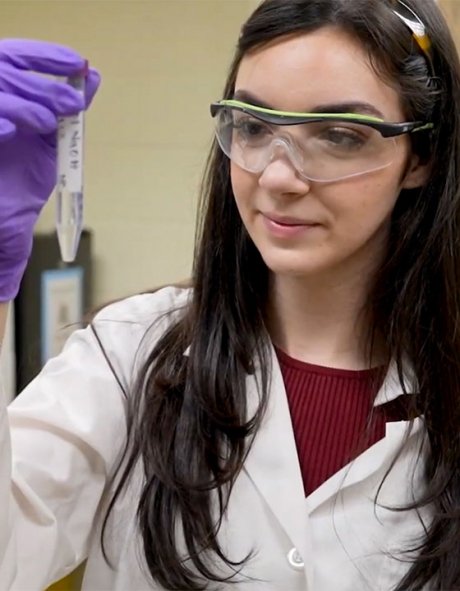
Studying the delicate structure of a tiny and translucent fish eye, Ella Lewis has spent countless hours in a lab at Rhode Island College searching for answers. This May, she will walk the stage to receive her degree in biology. In August, Lewis will take that same curiosity to the New England College of Optometry, where her journey into vision care continues.
Lewis knew from a young age that she wanted to pursue a career in the medical field, inspired by her mother, an optometrist and a Rhode Island College graduate. Watching her mother’s impact on patients shaped Lewis’ understanding of what it means to care for others, not only by improving a patient’s vision, but also by protecting their overall health.
“When I was in high school, my mom told me about an eight-year-old patient she had examined using an OCT scan of his optic nerve. She noticed something abnormal and diagnosed him with papilledema – a condition that, if left untreated, can lead to serious neurological damage or even death,” says Lewis. “Because she caught it early, she sent him straight to Rhode Island Hospital, where he was treated. Not only did she save his vision, but she also saved his life. I still remember her coming home that day in tears, overwhelmed by what had just happened.”
Lewis says that moment solidified her desire to follow in her mother’s footsteps, leading her to Rhode Island College, where she spent more than two-and-a-half years in biology labs.
Much of Lewis’ research work centered on zebrafish, a small freshwater species commonly used in vision research because of their strong similarities to human eyes, particularly in the retina, where visual-processing layers are organized similarly.
“Zebrafish are such an important model for human ocular research,” she says. “Being able to study the retina, understand its layers and actually see how everything works is incredibly valuable for what I want to do.”
Her research journey started under the guidance of Associate Professor of Biology Larissa Patterson.
“With Dr. Patterson, I began studying the number and distribution of melanophore pigment cells responsible for the zebrafish’s stripe patterns and coloration, which are relevant to human cancer research, such as melanoma,” says Lewis.
Though she began with zebrafish pigmentation, her interests evolved. She shifted toward vision-focused research under the guidance of Associate Professor of Biology Anabela Maria Resende da Maia.
Lewis conducted behavioral experiments designed to understand how fish respond to different visual stimuli. By manipulating factors such as light reflectivity, she observed how the fish reacted, collecting data that linked behavior to visual perception.
“With Dr. Maia, I worked with bluegill sunfish and performed multiple eye dissections,” she says. “I spent hours analyzing my behavioral data and studying bluegill eye anatomy images to further prepare myself for the rigors of optometry school.”
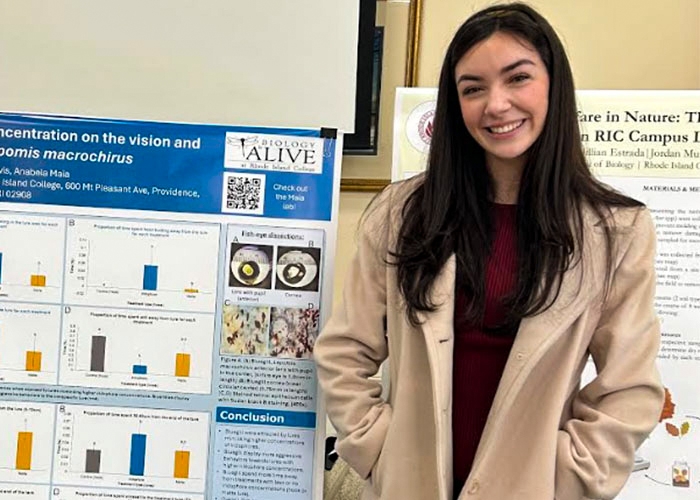
Moving from zebrafish pigmentation studies to behavioral experiments with an entirely different species required her to adapt quickly, learn new techniques and think about scientific questions from multiple perspectives.
Lewis later returned to zebrafish, this time focusing on the development, structure and function of the zebrafish eye, further connecting her early research on pigmentation to visual systems.
“It all started to come together,” Lewis says. “Even though I began with something that didn’t seem directly related to optometry, I was able to connect it back to vision in a meaningful way for my honors thesis. The hardest part was figuring out how to tie everything together so it tells one clear story.”
The experience reinforcing her understanding of how the brain and the visual system interact. Her work earned recognition, including the 2026 Theodore Lemeshka Scholarship and the 2025 Norma Dilibero Scholarship.
Outside the lab, Lewis balanced an equally demanding schedule. She worked multiple jobs as a barista, an optometric technician at a volunteer eye clinic, served as a biology tutor and was a Hope Scholarship ambassador. RIC’s Hope Scholarship makes the final two years of a four-year bachelor’s degree tuition-free for R.I. residents.
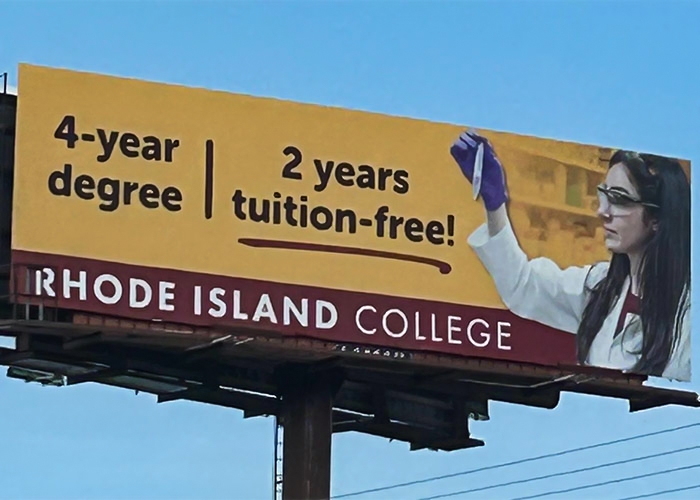
“Being a RIC Hope Scholarship ambassador is one of the most rewarding things that I’ve had the opportunity to participate in,” says Lewis. “It not only encouraged me to achieve my dream of becoming a doctor, but it also allowed me to enroll in multiple summer courses to complete my minors in chemistry and behavioral neuroscience.”
Through it all, she remained focused on her goal.
“Sometimes it felt intangible,” she says. “But education is what you make of it, and at Rhode Island College I’ve felt supported by professors who push me to succeed. Those opportunities helped me reach optometry school, and I hope to inspire at least one other student to believe they can do it too.”
All that involvement paid off when she received acceptance into the New England College of Optometry, a moment she describes as both emotional and validating.
“I remember seeing the email and immediately crying happy tears. I just felt this huge sense of relief,” she says. “All the hard work and all the late nights studying were worth it.”
As she prepares for clinical training, Lewis is focused on applying her research to patient care.
“At the New England College of Optometry, they expose you to working with patients within your first year, and then you work with them throughout your four years at optometry school,” she says. “I'm just excited to start helping patients and get that hands-on clinical experience.”
For Lewis, the connection between research and patient care is clear. From analyzing optical layers to interpreting visual behavior, she built a foundation that will carry into her clinical training.
“I want to make a difference in patients’ lives,” she says. “Not only by changing the way they see the world, but by improving their overall health.”
Learn more about RIC's Biology programs