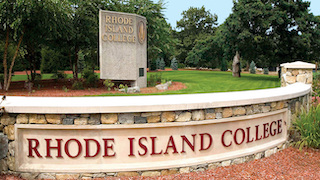
Whether you are joining us in person or via livestream, we are delighted to celebrate with you. If you are honoring a graduate student, please view the May 14 Advanced Degree Ceremony. If you are celebrating an undergraduate student on May 16, please refer to the Baccalaureate Degree Ceremony. You may also skip to a complete list of graduate names.
Manyul Im, Provost and Vice President for Academic Affairs
Honorary Degree Recipients | Advanced Degree
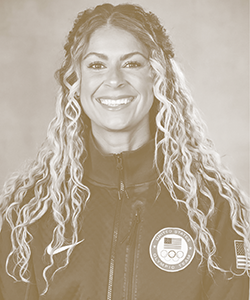
Elizabeth Beisel | Doctor of Humane Letters | Advanced Degree Speaker
Elizabeth Beisel is a three-time Olympic swimmer, two-time Olympic medalist, World Champion, two-time Emmy winner and NBC/ESPN broadcaster. She was born and raised in Rhode Island and continues to reside here today.
At 15 years old in 2008, she qualified for her first Olympic Games, making her the youngest competitor on the U.S. Olympic Team. Four years later, at the 2012 Olympics, she won two individual medals; a silver in the 400m Individual Medley and a bronze in the 200m Backstroke. At her third Olympics in 2016, she was named captain of the U.S. Olympic Swim Team alongside Michael Phelps.
Beisel attended the University of Florida, where she won two NCAA titles and 14 SEC titles. She earned a Bachelor of Science in telecommunications and was named the 2011 and 2013 NCAA Division I Scholar-Athlete of the Year.
In 2021 Beisel became the first – and still only – woman in history to swim to Block Island. Her 20km swim, named Block Cancer in memory of her father Ted Beisel who passed from pancreatic cancer, raised funds for cancer research and clinical trials. As of April 2026, Block Cancer has raised over $900,000 for cancer research.
Beisel currently works as a media correspondent for the Olympic Games and NCAA Championships. Her coverage at the 2024 Olympic Games in Paris won her two Emmy’s.
Alongside her career in athletics, music has remained a constant. A classically trained violinist and pianist, Beisel has performed as a soloist with orchestras that include the Pittsburgh Symphony and the Rhode Island Philharmonic. She has performed at the Newport Folk Festival, on The Today Show, on the CBS Morning Show and played the National Anthem in NFL and MLB stadiums.
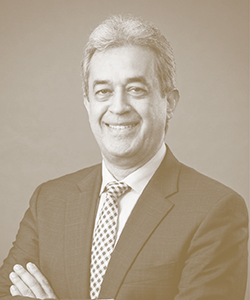
Oscar A. Mejías | Doctor of Business
Oscar Mejías is a nationally recognized business leader, economic development strategist and community advocate with more than two decades of experience driving entrepreneurial growth, workforce development and inclusive economic expansion in the United States.
Born in Venezuela and trained as a computer engineer, Mejías immigrated to the United States in 2003 and quickly established himself as a bridge between technology, business development and community empowerment. Over the past 20+ years, he has played a pivotal role in strengthening Rhode Island’s small business ecosystem, particularly within underserved and Hispanic communities.
As the founder and CEO of the Rhode Island Hispanic Chamber of Commerce, Mejías has built one of the most impactful minority business organizations in New England. Under his leadership, the Chamber has grown to serve more than 1,000 members, delivering technical assistance, access to capital, training programs and strategic advocacy that have directly contributed to business growth, job creation and increased economic participation across the state.
His leadership extends across multiple sectors. He has served as an IT Implementation Project Manager for a global financial institution (Santander Group). He is also the CEO of OM Consulting Group, a Rhode Island-based firm with a national footprint, specializing in business development, strategic marketing and organizational growth. He advises entrepreneurs, nonprofits and institutions on scaling operations, strengthening revenue models and building sustainable business strategies.
A respected voice in policy and economic development, Mejías has contributed to numerous advisory boards and committees, including the Rhode Island AI Task Force, Workforce Development Board (Providence/Cranston), RI Public Expenditure Council and various diversity, equity, and inclusion initiatives at both city and state levels.
His contributions have earned him multiple recognitions, including the SBA New England Minority Business Owner of the Year award and acknowledgment by the White House Initiative on Educational Excellence for Hispanics.
Michael Grey, Chair, Rhode Island Board of Education
David Caprio, Esq., Chair, Council on Postsecondary Education
Patricia DiCenso, Chair, Council on Elementary and Secondary Education
Dennis Algiere
Mary Barden
Amy Beretta, Esq.
Colleen A. Callahan
Karen Davis
Dennis J. Duffy, Esq.
Alexandra Ford
Jo Eva Gaines
Rachelle Green, Esq.
Marta V. Martinez
Michael Mello
Milissa O'Neil
Lawrence Purtill
Marcy Reyes
Bishop Jeffery A. Williams
Gianna M. Rose
Commissioner of Postsecondary Education
Shannon Gilkey
Commissioner of Elementary and Secondary Education
Angélica Infante-Green
Officers of Rhode Island College
President
Jack R. Warner
Provost and Vice President for Academic Affairs
Manyul Im
Vice President for Administration and Finance
Anastasia Rodriguez
Vice President of Corporate Relations and Professional Studies
Jenifer R. Giroux
Vice President for Student Success
Cindy Kozil
General Counsel, Assistant Vice President of Human Resources
Margaret Lynch-Gadaleta
Senior Advisor to President
Joseph Pratt
President Emeritus
John Nazarian
Symbols and Traditions of Rhode Island College
The Rhode Island College Seal
The official Rhode Island College seal (adopted in 1960) incorporates the anchor, a symbol of hope and of the state of Rhode Island, with the founding of the institution in 1854. The seal was designed by Edith C. Becker, professor emerita of art, who adapted the central flame symbol from the Holbrook Murals in the foyer of Roberts Hall. The flame is used in the murals to depict the energy that has, over the ages, supported the development of all living things and has led civilization to its highest intellectual achievements. In like manner, the flame in the Rhode Island College seal stands for the life of the body and the life of the mind, symbolizing the human and intellectual goals and achievements of Rhode Island College.
The Del Sesto Mace
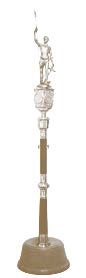
At the 1959 commencement exercises, the first held on the present Mount Pleasant campus, Governor Christopher Del Sesto presented to Rhode Island College a bronze replica of the statue of the Independent Man so that the college, which since 1898 had been located near the State House, might continue its tradition of holding commencements and other academic convocations in the presence of the Independent Man. The Del Sesto Mace, designed by the noted Rhode Island sculptor Aristide Cianfarani and crafted by the Gorham Company, has been in use since 1962 in all academic processions as a symbol of tradition and authority, as well as commitment to the search for truth, knowledge, beauty, values and learning.
The Presidential Medallion
The Presidential Medallion is a symbol of the office of the president. The medallion is appended to a chain that bears the names of the college and the chief executive officers who have led the institution. The medallion bears the names of all the principals and presidents to date; as well as the official names of the institution over time; the Rhode Island Normal School (1854-1920), Rhode Island College of Education (1920-1960) and Rhode Island College (1960-present).
Rhode Island College Colors
Rhode Island College's colors are gold and white, taken from the Rhode Island state flag. In 1986, burgundy was added as an accent color.
The Gonfalons of Rhode Island College
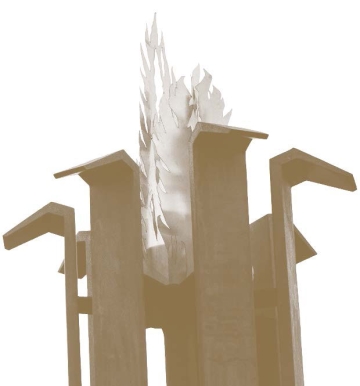
The gonfalons, a flag that hangs from a crosspiece or frame, serve as the backdrop of the stage platform. They represent each school of study that offers degree programs, whereby our graduates have excelled scholastically. Dating back to early European culture, in medieval Italy, gonfalons were carried through villages with pride as a symbol of the people it represented. As the Renaissance encouraged a more educated population, gonfalons were adopted as a symbol of academic institutions and are used in many academic ceremonies today.
History of Rhode Island College
Rhode Island College is the state’s first public institution of higher education. Established in 1854 by the Rhode Island General Assembly as the Rhode Island State Normal School, the school was founded to address the increasing demand for formally educated teachers in the state. First classes were held at the Second Universalist Church in Providence before moving in 1857 to free accommodations at the former Congregational meetinghouse in Bristol. Normal School operations were suspended in 1865, but the school reopened in 1871 in a building near Hoyle Square in Providence. In 1879 larger quarters were secured in a former Providence High School building, and in 1893 the first Observation and Training School was opened in a former grammar school a number of blocks away from the Normal School.
In 1898 a new and much grander home was completed on Providence’s Capitol Hill. The first floor was occupied by the Observation and Training School, named in honor of Henry Barnard in 1920. That same year the Normal School was rechartered as the Rhode Island College of Education (R.I.C.E.), gaining the authority to grant baccalaureate degrees and earning distinction as the first New England normal school to become a college of education. In 1925 the college offered its first graduate degree program – the Master of Education. Increased growth led to the opening of a separate building on the same campus to house the Henry Barnard School in 1928.
By the early 1950s the college was again in need of larger quarters. In the fall of 1958, a new 48-acre campus opened in the Mt. Pleasant section of Providence, with six buildings, 800 students and 65 faculty members. In 1959 the Rhode Island General Assembly assigned the institution a new mission; in addition to its teacher education programs, the college was to offer a comprehensive curriculum in the arts and sciences and to add a program in the industrial arts. To reflect its new mission, in 1960 the institution’s name was changed to Rhode Island College.
Over the past 67 years, the campus has grown to 180 acres and enrollment has expanded to over 6,000 students. The campus consists of 43 buildings, including six residence halls that can now accommodate 1,200 students. Academic offerings are provided in five schools: the Feinstein School of Education and Human Development, the Faculty of Arts and Sciences, the School of Business, the Onanian School of Nursing, and the School of Social Work.
Acknowledgements
The college would like to thank and acknowledge those who led our processions and made these ceremonies possible.
Commencement Directors
Amelia Rogers*
Patricia A. Nolin*
Rob Ferland
Faculty and Platform Marshals
Charles H. McLaughlin Jr.
Jason S. Anthony
Melissa A. Marcotte
Alexis Rogel*
Jessica Pearson
Eric Roberts
Elizabeth Kiesewetter*
Lead Marshals
Karley Batalon
Michael Cunningham
Jeanmarie Pariseau
Jessica Raffaele
Davis Rogers
Jonathan Rosa
The Commencement Office would also like to thank the following for their support of today’s ceremony:
Giselle Auger*
Ted August
Hayley Baccaire
Eric Blanchard
Nathan Cahoon
Michael Caine
Anne-Marie Cassidy
David Chabot
Alie Drew*
Kevin Fitta*
Aaron Fitzserny
Mollie Goodwin
Val Herbst
Orli Juarez*
Tim McDonald
Molly McKeon
James Mendonca
Christina Messina
Michelle Nicholas
Larissa Patterson*
Tiffany Pellett
Alan Pickart*
Matthew Richardson
Al Santilli
Eric Shoen
Richard Silva
Amal Simon
Amanda Solano*
Don Tencher
David Toms*
Shauna Trudell
Mike Ward
Bridgid Webster
William Wilson
Ted Zito
* Rhode Island College Committee on Convocations Member
172nd Baccalaureate Degree Commencement Ceremony
May 16, 2026, Amica Mutual Pavilion
Processional
Pomp and Circumstance No. 1 | Edward Elgar
Music from The Royal Fireworks | George Frideric Handel
National Anthem
Brianna Callahan, Alexander Celico, Makayla Dean, Jasmin Dowling, Abigail McNulty, Brianna Parrella, Michael Russell, Maija Spence, Shaylyn White
Welcome
Jack R. Warner, President of Rhode Island College
Greetings
The Honorable Daniel J. McKee, Governor of the State of Rhode Island
The Honorable Jack Reed, United States Senate
David Caprio, Esq., Chair, Council on Postsecondary Education
Presentation and Conferral of Honorary Degrees
Manyul Im, Provost and Vice President for Academic Affairs
Honorary Degree Recipients | Baccalaureate Degree
Darlene Allen | Doctor of Humane Letters | Baccalaureate Degree Speaker
Darlene Allen is an experienced nonprofit leader who has dedicated her 40+ year career to helping vulnerable children, youth and families. She has worked in both public and private agencies in areas that include adoption, child welfare, children’s behavioral health, foster youth education and the prevention of youth homelessness.
For the last 26 years, she has served as CEO and executive director of Adoption Rhode Island, a private nonprofit that provides a range of trauma-informed, evidence-based services for foster and adopted children, transition-age youth, young adults and families. The agency also provides education, training and technical assistance to professionals who work with these populations.
A frequent presenter and public speaker, Allen has tirelessly advocated – locally and nationally – for legislation and resources to address the educational, housing and mental health needs of children and youth impacted by foster care. The results of her efforts include passage of legislation that establishes requirements for the Office of Child Advocate regarding fatality reviews. Allen was also appointed a member of the Rhode Island Child Fatality review team.
Allen has also been a long-time partner in education with Rhode Island College. In 2006 she was instrumental in establishing the Adoption and Foster Care Certificate program at RIC, which successfully served hundreds of students for more than 14 years. With the support of RIC, Adoption Rhode Island also launched an online certificate course called “From Lived Experience to Informed Practice,” open to students and professionals. In 2024 she worked with RIC, along with members of the legislature and the governor’s office, to establish the Foster Care Youth Scholarship Program. This program is currently serving its second cohort of former foster youth. For her work, Allen has received numerous awards, including a Congressional Angel in Adoption award.
Mathies J. Santos | Doctor of Public Service
Retired Lt. Col. Mathies Santos served for more than 31 years with the U.S. Air Force and the R.I. Air National Guard. His last assignments included a 2008-09 deployment to Afghanistan in support of “Operation Enduring Freedom,” where he worked on the rebuilding of the Afghan National Army Air Corps and as commander of the 143rd Airlift Wing's Force Support Squadron.
During this period, his outstanding professional skill, leadership and ceaseless efforts resulted in major contributions to the success of the U.S. Air Force Advisor Mission in support of Operation Enduring Freedom. For his outstanding accomplishments, Santos was awarded the Air Force’s Meritorious Service Award with 3rd Oak Leaf Cluster.
Santos is a native Rhode Islander and product of the Providence Public Schools. A 1965 graduate of Hope High School, he holds a degree from Brown University, ’77, in Italian Studies and Secondary Education and from Rhode Island College, ’82, in managerial economics.
Santos retired from state service in 2003 as executive assistant to the commissioner and director of equity and access at the Rhode Island Department of Education. He also formerly worked at Rhode Island College, the Executive Branch and the Department of Administration.
Appointed to the Board of Regents for Elementary and Secondary Education in 2011, Santos chaired the board’s Appeals Committee and served on a year-long National Association of State Boards of Education study group called the “Role of Technology in Schools and Communities.”
Matt Duncan, Vice Chair, Council of Rhode Island College
Kevin F. San '12, MPAc '13, Co-Chair, Rhode Island College Alumni & Foundation
Rhode Island College Wind Ensemble
Joseph D. Foley, Conductor
2026 Class Officers
Orli Juarez, President
Nilah Dereje, Vice President
Miguel Hoyos, Treasurer
Riley Jackman, Secretary
Graduation with Academic Distinction
Baccalaureate degree candidates with the following G.P.A.:
Cum Laude: G.P.A. of 3.25 to 3.59 (white cord)
Magna Cum Laude: G.P.A. of 3.60 to 3.84 (burgundy cord)
Summa Cum Laude: G.P.A. of 3.85 or higher (gold cord)
Hope Scholars (gold & white cord)
Government Officials
Governor of the State Of Rhode Island
The Honorable Daniel J. McKee
Rhode Island Board Of Education
Michael Grey, Chair, Rhode Island Board of Education
David Caprio, Esq., Chair, Council on Postsecondary Education
Patricia DiCenso, Chair, Council on Elementary and Secondary Education
Dennis Algiere
Mary Barden
Amy Beretta, Esq.
Colleen A. Callahan
Karen Davis
Dennis J. Duffy, Esq.
Alexandra Ford
Jo Eva Gaines
Rachelle Green, Esq.
Marta V. Martinez
Michael Mello
Milissa O'Neil
Lawrence Purtill
Marcy Reyes
Bishop Jeffery A. Williams
Gianna M. Rose
Commissioner of Postsecondary Education
Shannon Gilkey
Commissioner of Elementary and Secondary Education
Angélica Infante-Green
Officers of Rhode Island College
President
Jack R. Warner
Provost and Vice President for Academic Affairs
Manyul Im
Vice President for Administration and Finance
Anastasia Rodriguez
Vice President of Corporate Relations and Professional Studies
Jenifer R. Giroux
Vice President for Student Success
Cindy Kozil
General Counsel, Assistant Vice President of Human Resources
Margaret Lynch-Gadaleta
Senior Advisor to President
Joseph Pratt
President Emeritus
John Nazarian
Symbols and Traditions of Rhode Island College
The Rhode Island College Seal
The official Rhode Island College seal (adopted in 1960) incorporates the anchor, a symbol of hope and of the state of Rhode Island, with the founding of the institution in 1854. The seal was designed by Edith C. Becker, professor emerita of art, who adapted the central flame symbol from the Holbrook Murals in the foyer of Roberts Hall. The flame is used in the murals to depict the energy that has, over the ages, supported the development of all living things and has led civilization to its highest intellectual achievements. In like manner, the flame in the Rhode Island College seal stands for the life of the body and the life of the mind, symbolizing the human and intellectual goals and achievements of Rhode Island College.
The Del Sesto Mace
At the 1959 commencement exercises, the first held on the present Mount Pleasant campus, Governor Christopher Del Sesto presented to Rhode Island College a bronze replica of the statue of the Independent Man so that the college, which since 1898 had been located near the State House, might continue its tradition of holding commencements and other academic convocations in the presence of the Independent Man. The Del Sesto Mace, designed by the noted Rhode Island sculptor Aristide Cianfarani and crafted by the Gorham Company, has been in use since 1962 in all academic processions as a symbol of tradition and authority, as well as commitment to the search for truth, knowledge, beauty, values and learning.
The Presidential Medallion
The Presidential Medallion is a symbol of the office of the president. The medallion is appended to a chain that bears the names of the college and the chief executive officers who have led the institution. The medallion bears the names of all the principals and presidents to date; as well as the official names of the institution over time; the Rhode Island Normal School (1854-1920), Rhode Island College of Education (1920-1960) and Rhode Island College (1960-present).
Rhode Island College Colors
Rhode Island College's colors are gold and white, taken from the Rhode Island state flag. In 1986, burgundy was added as an accent color.
The Gonfalons of Rhode Island College
The gonfalons, a flag that hangs from a crosspiece or frame, serve as the backdrop of the stage platform. They represent each school of study that offers degree programs, whereby our graduates have excelled scholastically. Dating back to early European culture, in medieval Italy, gonfalons were carried through villages with pride as a symbol of the people it represented. As the Renaissance encouraged a more educated population, gonfalons were adopted as a symbol of academic institutions and are used in many academic ceremonies today.
History of Rhode Island College
Rhode Island College is the state’s first public institution of higher education. Established in 1854 by the Rhode Island General Assembly as the Rhode Island State Normal School, the school was founded to address the increasing demand for formally educated teachers in the state. First classes were held at the Second Universalist Church in Providence before moving in 1857 to free accommodations at the former Congregational meetinghouse in Bristol. Normal School operations were suspended in 1865, but the school reopened in 1871 in a building near Hoyle Square in Providence. In 1879 larger quarters were secured in a former Providence High School building, and in 1893 the first Observation and Training School was opened in a former grammar school a number of blocks away from the Normal School.
In 1898 a new and much grander home was completed on Providence’s Capitol Hill. The first floor was occupied by the Observation and Training School, named in honor of Henry Barnard in 1920. That same year the Normal School was rechartered as the Rhode Island College of Education (R.I.C.E.), gaining the authority to grant baccalaureate degrees and earning distinction as the first New England normal school to become a college of education. In 1925 the college offered its first graduate degree program – the Master of Education. Increased growth led to the opening of a separate building on the same campus to house the Henry Barnard School in 1928.
By the early 1950s the college was again in need of larger quarters. In the fall of 1958, a new 48-acre campus opened in the Mt. Pleasant section of Providence, with six buildings, 800 students and 65 faculty members. In 1959 the Rhode Island General Assembly assigned the institution a new mission; in addition to its teacher education programs, the college was to offer a comprehensive curriculum in the arts and sciences and to add a program in the industrial arts. To reflect its new mission, in 1960 the institution’s name was changed to Rhode Island College.
Over the past 67 years, the campus has grown to 180 acres and enrollment has expanded to over 6,000 students. The campus consists of 43 buildings, including six residence halls that can now accommodate 1,200 students. Academic offerings are provided in five schools: the Feinstein School of Education and Human Development, the Faculty of Arts and Sciences, the School of Business, the Onanian School of Nursing, and the School of Social Work.
Acknowledgements
The college would like to thank and acknowledge those who led our processions and made these ceremonies possible.
Commencement Directors
Amelia Rogers*
Patricia A. Nolin*
Rob Ferland
Faculty and Platform Marshals
Charles H. McLaughlin Jr.
Jason S. Anthony
Melissa A. Marcotte
Alexis Rogel*
Jessica Pearson
Eric Roberts
Elizabeth Kiesewetter*
Lead Marshals
Karley Batalon
Michael Cunningham
Jeanmarie Pariseau
Jessica Raffaele
Davis Rogers
Jonathan Rosa
The Commencement Office would also like to thank the following for their support of today’s ceremony:
Giselle Auger*
Ted August
Hayley Baccaire
Eric Blanchard
Nathan Cahoon
Michael Caine
Anne-Marie Cassidy
David Chabot
Alie Drew*
Kevin Fitta*
Aaron Fitzserny
Mollie Goodwin
Val Herbst
Orli Juarez*
Tim McDonald
Molly McKeon
James Mendonca
Christina Messina
Michelle Nicholas
Larissa Patterson*
Tiffany Pellett
Alan Pickart*
Matthew Richardson
Al Santilli
Eric Shoen
Richard Silva
Amal Simon
Amanda Solano*
Don Tencher
David Toms*
Shauna Trudell
Mike Ward
Bridgid Webster
William Wilson
Ted Zito
* Rhode Island College Committee on Convocations Member
The Commencement Office works to ensure that our graduates, their families, and our campus community enjoys a memorable ceremony and celebration that is student-centered and family oriented.