
Dr. Deborah E. Britt
- Assistant Professor


This is a repository created to provide guidance and resources to ensure that any research involving recombinant DNA or biological material is conducted in a manner that protects the health of researchers, the RIC community, and the environment.
Some of these guidance require active participation of principal investigators to comply and adhere to the policies of RIC, Centers for Disease Control, National Institutes of Health, National Science Foundation, and Occupational Safety and Health Administration.
We appreciate efforts to streamline project registration procedures and welcome any suggestions from principal investigators and the broader community.
Your compliance is crucial to the success of the goals of the RIC Biosafety Program. Those working with recombinant DNA (rDNA) and/or biological materials are required to submit a Biological Project Registration Form to the Institutional Biosafety Committee. In some cases the form must go through review before laboratory work may begin. These activities are exempt from full review, but still require the submission of a Biological Project Registration to the IBC.
Activities involving Biological Materials, work with live organisms, and animals have varied protocols:
Use of the following Select Agents in research must go through IBC approval before obtaining materials:
Abrin, Conotoxins, Diacetoxyscirpenol (DAS), Ricin, Saxitoxin, Tetrodotoxin, Shiga-like ribosome inactivating proteins, Botulinum neurotoxins, Clostridium perfringens epsilon toxin, Shigatoxin, Staphylococcal enterotoxins, T-2 toxin
Training is mandatory for faculty, staff, and students engaged in activities involving recombinant DNA and/or unfixed biological materials.
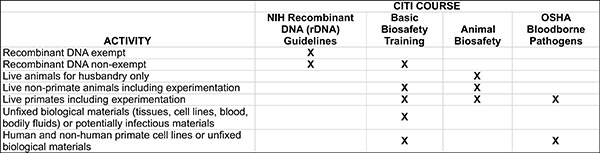
Training is through the Collaborative Institutional Training Initiative (CITI).
The Institutional Biosafety Committee (IBC) has been established as specified in the NIH Guidelines for Research Involving Recombinant DNA Molecules and CDC Guidelines for Biosafety in Microbiological and Biomedical Laboratories. The RIC IBC oversees research involving recombinant DNA, and develops policies and provides expertise to reduce risks to faculty, staff and students working with biohazardous materials and recombinant DNA technology. RIC IBC reviews research protocols to determine whether a Principal Investigator (PI) who administers, handles or uses biological materials employs containment, decontamination, and disposal procedures in compliance with federal, state and local regulations, and ensures users are properly trained in good microbiological techniques.
IBC composition, standards, and procedures follow the NIH Guidelines For Research Involving recombinant DNA molecules Sections I-E-2 through IV-B-2-b-(9)). The RIC IBC is comprised of six members with expertise in recombinant DNA technology and the capability to assess any potential risk of research activities to public health or the environment; four members are RIC faculty and two members are not affiliated with RIC, as stipulated by the NIH Guidelines.
The RIC IBC provides resources, forms and templates at the IBC website (www.ric.edu/biosafety). Researchers can access this site to register their research involving recombinant DNA molecules and cell/tissue culture experiments. Once received, the IBC reviews research registration forms to ensure procedures are in place to protect faculty, staff, and students from biological materials.